 OnlineJobs
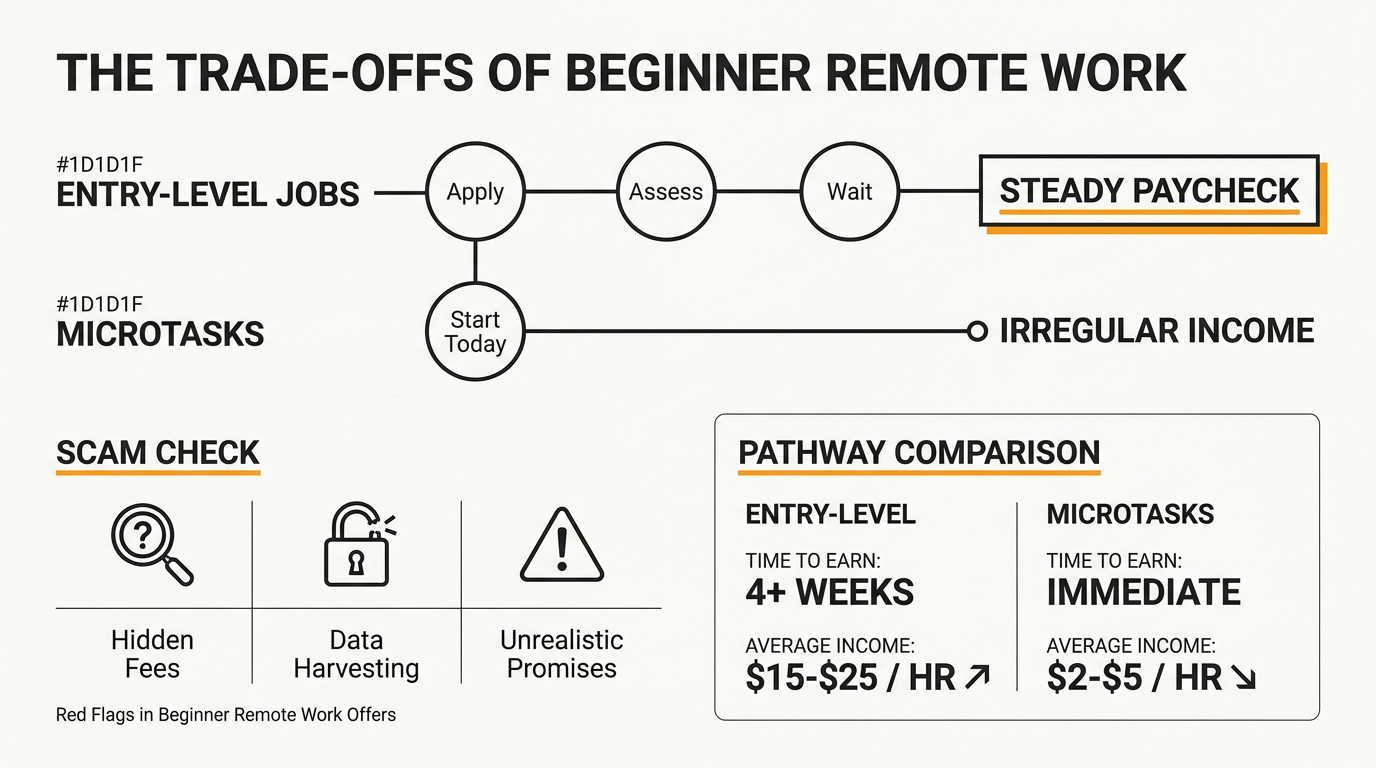
Key takeaway: The best work-from-home option with no experience depends on what you need. If you want a real paycheck, apply for customer service, chat support, data entry, or office-support roles [2][4]. These usually involve an application, an assessment, and a wait before your first payday. If you want flexible side income, surveys and microtasks are faster to try, but pay is irregular and often low once you count unpaid time [8][9]. Never pay to get hired or to unlock earnings [3].
Why "No Experience" Doesn't Mean "Easy Money"
What can you do from home when your resume is basically blank? More than you might think, but less than the ads promise.
The options fall into two groups:
- Entry-level remote jobs such as customer service or office support can offer steadier hours and a real paycheck, if you get hired.
- Microtasks, surveys, and app offers can start the same day and pay through PayPal, gift cards, or crypto. Income is irregular and often low once you count unpaid time.
"Remote" also does not mean available everywhere. Employers restrict hiring by location for tax and legal reasons, so a US work-from-home listing may still exclude you if you live in Europe. One industry guide notes that a beginner role that is remote inside one country usually won't hire someone from another [4]. If you're outside the US, filter job boards by your own country first.
This guide covers realistic pay ranges, hiring timelines, Amazon roles, scam checks, and the hidden time cost of task work. It doesn't guarantee hiring, task availability, or earnings.
A note on wage figures: The Bureau of Labor Statistics (BLS) May 2025 customer-service wage cited below is the occupation's national median, as reported by Remote Nomad Jobs [4]. It is not a promised beginner wage.
The Easiest Work-From-Home Jobs With No Experience, Ranked by Realistic Pay
If you want a job, customer service and data entry are the most accessible no-experience paths. If you want flexible side income, surveys and microtasks are. "Easiest" can mean easiest to qualify for, fastest to start, or simplest to do, and those aren't the same thing. None of these options guarantees a living wage or immediate earnings.
Compare beginner options by pay, hiring, and time to first earnings
No-Experience Remote Options: Realistic Comparison
| Option | Pros | Cons |
|---|---|---|
| Remote Customer Service | Steadier hours, real paycheck, employers train new hires | Application, assessments, wait for payroll cycle |
| Data Entry / Office Support | Accessible, learnable from scratch, median ~$21.64/hr | Competitive listings, scam impersonation risk |
| MTurk / Microtasks | Start same day, flexible hours | Median ~$2/hr effective pay, unpaid searching time |
| Surveys & Offers | Fast to start, fits odd hours | $0.25-$5 per survey, screen-outs, inconsistent volume |
| Option | What beginners do | Evidence-based pay context | Application or setup | Time to first earnings | Main limitation |
|---|---|---|---|---|---|
| Remote customer service | Answer questions by phone, chat, or email | BLS national median: $21.53/hour in May 2025; not an entry-level guarantee [4] | Employer application; interview or assessment may apply | Depends on hiring and payroll schedule | Shifts, location eligibility, customer-facing work |
| Data entry or office support | Enter, check, or organize information | BLS median for office clerks: $21.64/hour in May 2025 [4] | Application and skills checks may apply | Depends on selection and payroll | Competitive listings, scam impersonation risk |
| MTurk tasks | Research or data-labeling tasks | One cited study reports a median of roughly $2/hour; results vary [8] | Account setup and task qualification | Depends on task availability and payout rules | Low effective pay, unpaid searching time |
| Surveys and offers | Surveys, app offers, similar activities | Platform pages put most surveys at roughly $0.25 to $5; estimates, not wages | Account creation and eligibility screening | Varies by completion and withdrawal threshold | Screen-outs, limited invitations, inconsistent volume |
| OnlineJobs tasks | Available platform tasks or offers | No verified platform-wide hourly average; check current terms | Signup and task selection per site terms | Depends on crediting and withdrawal rules | Availability, eligibility, payment-processing terms |
How to read these pay figures
Wage medians. The $21.53 figure is a national occupational median reported through a secondary source [4]. By definition, half of all customer service representatives earn less. The lowest 10% earned under $15.27 an hour in customer service and under $14.57 as office clerks. Beginner offers tend to land in that lower band, not at the median [7].
MTurk research. Hara et al. (2018) analyzed about 3.8 million tasks completed by 2,676 workers. They found a median of roughly $2 per hour, and only 4% of workers earned above $7.25 [8]. That is one study of one platform, as summarized by CASRAI. Treat it as a warning sign, not a current rate for everyone.
Surveys and offers. Platforms vary widely. Most surveys pay somewhere around $0.25 to $5. InboxDollars, for example, lists some surveys and offers at $0.25 to $15. Payout methods across reward platforms commonly include PayPal, gift cards, and crypto [6]. Higher-paying offers usually take more time, such as app trials or sign-ups, and often carry stricter eligibility rules.
Where the jobs are. FlexJobs, an industry job-search service, lists entry-level remote openings across 25 career fields, including administrative support, customer service, billing, data entry, and writing [2]. Data entry and chat support are among the easiest to learn from scratch. The list shows where to look, not how easy those jobs are to land.
Match the option to your goal
Want steadier employment? Research customer service or office-support roles and prepare for screening. Employers in these occupations train new hires, which is why "no experience" listings appear there [4]. Treat any single salary range you see on a job board as a snapshot, not a market rate.
Want flexible side income around classes or another job? Tasks and surveys can fit odd hours. Treat them as extra money, not dependable weekly wages.
Either way, "no experience" doesn't mean "no requirements." Typing checks, communication standards, location rules, age minimums, and identity verification can all still apply [7]. If a post says "no experience" and then asks for three years in Zendesk, the label is wrong. Read the requirements, not the headline.
Can you make $1,000 a week without experience?
⚠️ The $1,000/Week Reality Check
At the BLS May 2025 customer-service median of $21.53/hour, earning $1,000 gross takes about 46.4 paid hours before taxes. A new hire's actual wage may be well below the median, pushing required hours higher. For microtasks and surveys, $1,000 a week isn't a realistic goal.
Here's the math. At the BLS May 2025 customer-service median of $21.53 an hour, earning $1,000 gross takes about 46.4 paid hours before taxes [4]. That's an illustration, not a forecast. A new hire's actual wage may be well below the median, which pushes the required hours higher.
For microtasks and surveys, $1,000 a week isn't a realistic goal. Task volume, screening rejections, unpaid search time, and location limits all pull effective earnings down [8][9]. Anyone promising otherwise is usually selling something.
Apply-and-Wait Jobs Versus Start-Earning-Today Tasks
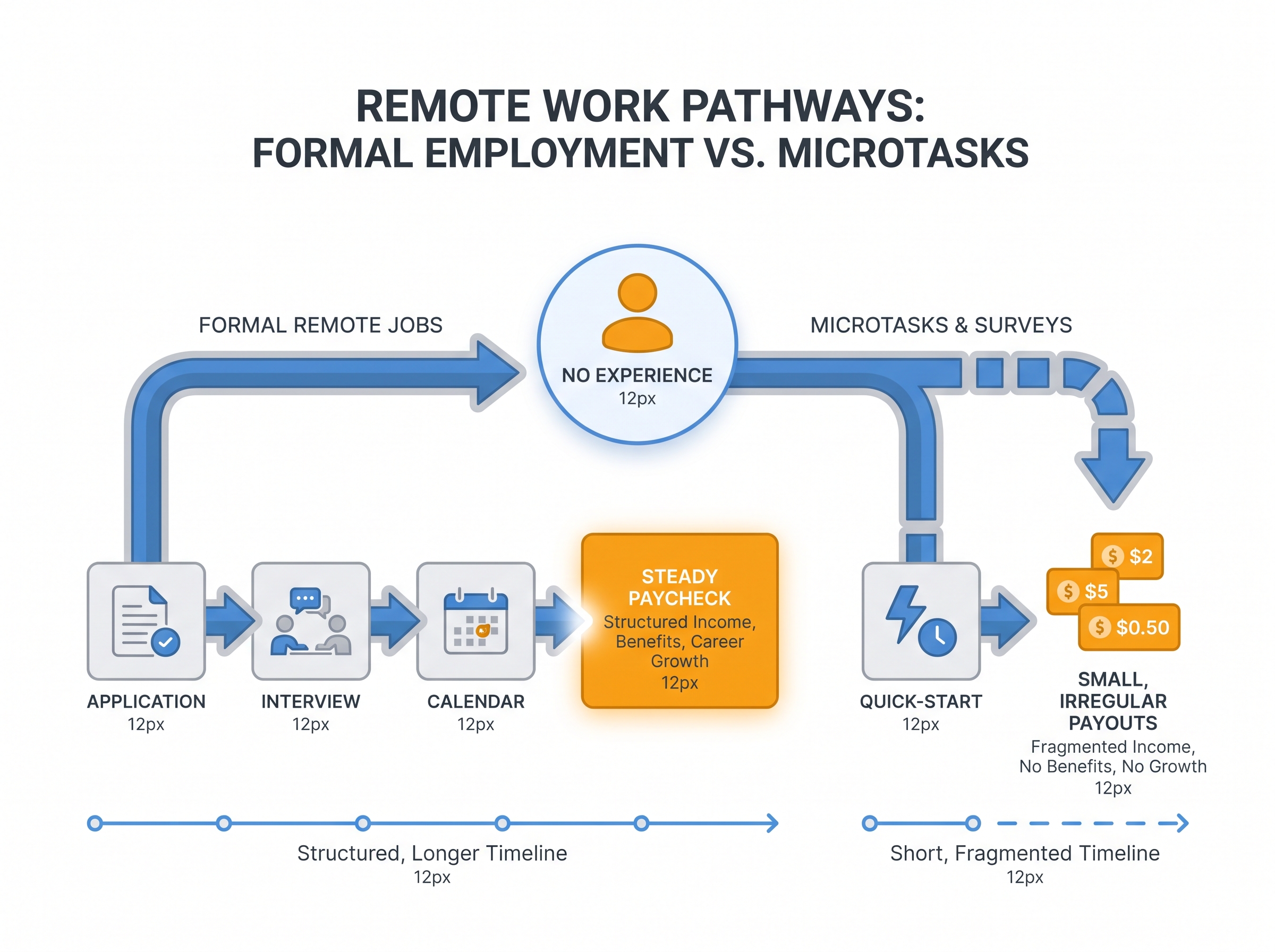
Formal remote jobs and task platforms get you to your first dollar in different ways. With a job, you apply, take assessments, interview, and then wait through onboarding and payroll. A task platform may let you start sooner, but availability, qualification rules, and cash-out rules still decide when you actually get paid.
The formal remote hiring funnel
The usual sequence:
- Find a role and confirm you're eligible for its location and schedule.
- Submit your application and resume.
- Complete any requested tests, such as a typing check or a mock customer ticket [7].
- Interview.
- Clear background or identity checks where they apply.
- Onboard, then wait for your first scheduled payday.
Plan for several weeks between applying and your first paycheck. Timelines vary by employer, and nobody can promise a start date.
Build a resume when you have no work history
Even "no experience" listings screen resumes. Zety's resume guidance recommends four things [5]:
- Focus on accomplishments rather than duties.
- Tailor the resume to each company.
- Start each bullet with an action verb.
- Use numbers wherever you can.
School projects, volunteering, and personal projects all count. "Answered 40+ customer emails weekly for a campus club" tells a recruiter more than "Responsible for communication." It won't replace a required qualification, but it beats a blank page.
Useful skills to highlight for remote support roles include typing speed, written clarity, comfort with chat tools and spreadsheets, and reliability with a schedule. If you've moderated a Discord server or handled orders for a small online shop, that's relevant customer-facing experience.
The task-platform route and its trade-offs
Typical steps:
- Register and review the eligibility and payout rules.
- Pick a task and complete it.
- Confirm the credit shows up in your account.
- Reach the withdrawal minimum and request a payout.
- Wait for processing.
Access to a task is not money you can withdraw. Don't assume signup, first task, and first payout happen on the same day unless current terms confirm each step.
| Stage | Formal job | Task platform | What can delay it |
|---|---|---|---|
| Entry | Application and screening | Account registration | Location or eligibility rules |
| Prove yourself | Assessments, interview | Task qualification tests | Failed checks, limited slots |
| First work | Scheduled shifts after onboarding | Pick from available tasks | Low task volume |
| First money | First payroll cycle | Reach withdrawal minimum, then processing | Thresholds, fees, review holds |
Some platforms also rate the quality of your work over time, so weak ratings can mean fewer tasks.
Choose a path based on your needs
Apply for formal jobs if you need predictable hours, a supervisor, and real employment terms. Choose microtasks as extra income if flexibility matters more than consistency. Many beginners do both: tasks for small, quick earnings while job applications work through the hiring funnel.
One warning applies to both paths. A "start today" claim doesn't prove an offer is legitimate. According to FTC guidance summarized by JobScamScore, offers you never applied for and any request for a deposit are classic red flags [3]. Scammers use speed as a selling point, so verify the offer yourself.
Is Amazon Work From Home Real? What to Expect
Yes. Amazon lists some remote roles, but not every role is remote, open nationwide, or available without screening. Coursera's guide to Amazon careers notes that most Amazon jobs are tied to a location and that most remote opportunities are in customer service. Check current openings and location requirements on Amazon's own careers site before you apply.
What "Amazon remote" can mean
This search covers three very different things:
- A real remote employee role with Amazon.
- A flexible gig or app-based task that mentions Amazon.
- A scam that uses the Amazon name.
Coursera is describing where Amazon's remote work tends to cluster, not promising current beginner openings. Location, schedule, and role-specific qualifications still apply, and they change.
Amazon hiring steps and realistic expectations
Expect an application, a work-style assessment, and pre-hire orientation where it applies. The process varies by position. Rely on live Amazon listings rather than any third-party summary, including this one.
Verify any Amazon-branded offer
✅ How to Verify an Amazon Remote Offer
Always find the listing on Amazon's official careers site. Never trust a repost, a search snippet, or a social media message on its own. Confirm the job title, work location, schedule, and required assessments directly from the source.
Before applying anywhere that claims to be Amazon:
- Find the listing on Amazon's official careers site. Never trust a repost, a search snippet, or a social media message on its own.
- Confirm the details. Check the job title, work location, schedule, and required assessments.
- Never pay for an interview, equipment, training, or a "guaranteed" role. FTC guidance is clear that you should never pay for the promise of a job [3].
Listings change quickly. Always check the original source.
How to Spot Work-From-Home Scams
A real work-from-home job won't ask you to pay to get the role. No legitimate employer will ask a new hire to deposit a check and send part of the money back. Verify the company through contact details you find yourself, and be skeptical of vague offers that promise high pay for little work.
Use a concrete red-flag checklist
FTC consumer guidance, as compiled in JobScamScore's red-flag list [3], comes down to these checks:
- Upfront payment. Refuse any fee for a job, training, equipment, certification, or "special access."
- Fake-check scheme. Never deposit an employer's check and send money back or buy equipment from their chosen vendor. The check will bounce, and you'll owe the bank.
- Unsolicited task offer. Be suspicious of unexpected texts, WhatsApp messages, or app messages that give few job details.
- Unrealistic pay. Compare pay against the duties, hours, and credible wage data. A big number for trivial work deserves a closer look.
- Pressure or secrecy. Stop if you're told to act immediately, share sensitive data before you've verified the employer, or move off normal hiring channels.
- Money movement. Never receive and forward money or cryptocurrency for an employer. That is how people become "money mules" for stolen funds.
How large the job-scam problem is
The Consumer Federation of America's report on the scam economy estimates $1.9 billion in true losses from employment scams in 2024 [10]. That covers fake job offers, upfront-payment schemes, and money-moving schemes. It is a 2024 estimate based on CFA's methodology, so check the latest edition for current numbers.
A salary far above BLS benchmarks with zero requirements is a reason to verify the employer before you share anything.
Make a safe decision before sharing information
Search the employer's name plus "scam," "complaint," or "review." Then verify the role through the company's own website or phone number, found independently, not through the contact details in the message you received [3].
Keep your Social Security number (or national ID number) and bank details to yourself until you've verified the employer and reached a legitimate hiring stage. If you've already sent money or shared sensitive data, contact your bank right away. In the US, report it to the FTC. In Europe, report it to your national consumer protection authority or local police.
The Hidden Time Cost of Gig Work and How to Reduce It
A task's listed reward is not an hourly rate. Searching for work, qualifying, waiting for approval, and reaching a withdrawal minimum all take time you aren't paid for. Measure your total time, not just completed-task time, before deciding a platform is worth it.
Unpaid time: what the research shows
📊 The Invisible Labor of Gig Work
In one study, MTurk workers spent a median of 33 minutes a day on unpaid activities like finding tasks and taking screeners. This cut their effective hourly wage from $3.76 to $2.83 — a drop of about 25%.
An IntechOpen chapter on crowdwork reports a telling finding. In one study, MTurk workers spent a median of 33 minutes a day on unpaid activities. That cut their median effective hourly wage from $3.76 to $2.83 [9], a drop of about 25%. Researchers call this "invisible labor": finding tasks, taking screeners, waiting on approvals, and handling admin. Nobody pays you for it.
These figures describe one crowdwork sample, not every worker on every platform. They don't predict your results, but they reveal a built-in gap: effective hourly pay is lower than the listed reward.
Calculate your effective hourly rate
⏱️ Log All Session Time
Record the start and end time of every session, not just each task.
Record Rejections
Note rejected tasks and screen-outs that ate your time without pay.
Track Reward Crediting
Note when rewards are credited and when payouts actually arrive.
Calculate the Rate
Divide total rewards by total logged hours at the end of the week.
Use this formula:
Effective hourly rate = total rewards received ÷ all time spent finding, qualifying for, and completing tasks.
If you earn $6 over two hours in total, including searching and screen-outs, your effective rate is $3 an hour. That's sample arithmetic, not real earnings data. A "$2 survey" that takes 25 minutes once you count a screen-out works out to under $5 an hour.
Try this one-week test:
- Log the start and end time of every session, not just each task.
- Record rejected tasks and screen-outs.
- Note when rewards are credited and when payouts actually arrive.
- Divide total rewards by total logged hours at the end of the week.
If the number is far below what a part-time job would pay, that tells you where your time is better spent.
Reduce friction without expecting higher earnings
A lower withdrawal threshold means you can cash out sooner. It does not increase what you earn overall. Finder has reported a $1 minimum on Scrambly, and Swagbucks lists a $5 minimum for PayPal withdrawals; check both against current terms.
Before you invest time in any platform, check current terms for fees, payout methods, country availability, processing times, and minimum withdrawals.
Starting With OnlineJobs
OnlineJobs is one option for flexible, task-based earning. It is not a guaranteed job or paycheck. Most task platforms pay small amounts per task, so plan around current terms rather than headline claims.
First steps and payment checks
A sensible sequence:
- Visit the OnlineJobs official site.
- Read the current task and eligibility terms.
- Review payment options and thresholds.
- Select an available task.
- Confirm how rewards are credited.
- Check the payout procedure before you put in real time.
The homepage lists cash-out options including PayPal, Venmo, bank transfer, Visa, gift cards, and cryptocurrency. Confirm which options work in your country, along with fees and processing times. We don't promise "instant" payment or a specific withdrawal minimum, because terms change.
One rule applies everywhere: never pay to unlock tasks or withdraw earnings. FTC task-scam guidance treats that demand as a clear sign of a scam [3].
Set expectations and find related guides
Task availability and earnings vary by person, location, and day. We don't quote per-offer payouts or same-day earnings unless they're backed by current, verifiable terms.
Treat task work as extra income while you explore formal job options. For more on specific categories, see our guides to surveys for money and apps that make money. They go into more detail, but they aren't proof of earnings.
Frequently Asked Questions
What is the easiest online job with no experience?
It depends on whether you mean easiest to qualify for or quickest to try. Customer service and data entry often accept beginners but involve screening. Surveys and microtasks start faster, but pay and availability vary.
Is Amazon work from home a real thing?
Yes. Amazon has remote roles, mostly in customer service, but hiring depends on the listing. Find it on Amazon's official careers site and confirm location, schedule, and requirements.
How can I make $1,000 a week working from home?
Don't expect a no-experience remote job or task app to pay $1,000 a week. At the BLS May 2025 customer-service median of $21.53 an hour, $1,000 gross takes about 46.4 paid hours before taxes [4]. A new worker's actual pay and hours may be lower.
How can I work remotely from home with no experience?
Start with entry-level roles that train new hires. Prepare a tailored resume that highlights school, volunteer, or personal projects, and expect skills checks [5]. If you prefer tasks, check payout terms and treat the income as extra.
What are beginner-friendly remote jobs?
Customer service, chat support, data entry, and some administrative roles are common starting points [2][4]. Confirm the role is fully remote and open where you live.
Can I get a US remote job if I live in Europe?
Usually not as an employee. Many remote roles are limited to one country for tax and legal reasons. Filter listings by your own country and read the location requirements before applying.
What should I avoid when working remotely?
Avoid paying to get hired, depositing checks and sending money back, and sharing sensitive data before verifying an employer [3]. Walk away if you're asked to pay to unlock earnings.
Limitations, Alternatives, and Professional Guidance
No single option fits every beginner. Formal jobs and microtasks differ in stability, requirements, and time to payment. Earnings figures depend on source, method, worker, and date, and none is a guarantee. If you need dependable income, compare verified job openings and their full terms. Income from jobs, surveys, and task apps may be taxable; this article is not personal tax, legal, or financial advice, so consult a qualified tax professional or your local tax authority if you're unsure.
Conclusion
Formal entry-level remote roles give you a clearer employment structure, but they require screening and patience. Tasks and surveys give you flexibility, but unpaid time lowers your real hourly rate [9]. The BLS national median is a benchmark, not a beginner wage [4], and a task's advertised reward is not an effective hourly rate.
Before you commit to anything, check four things:
- Are you eligible for this role or platform where you live?
- How much total time does the work take, including unpaid time?
- What are the payout terms, thresholds, and fees?
- Does the offer pass the scam red-flag checks above [3]?
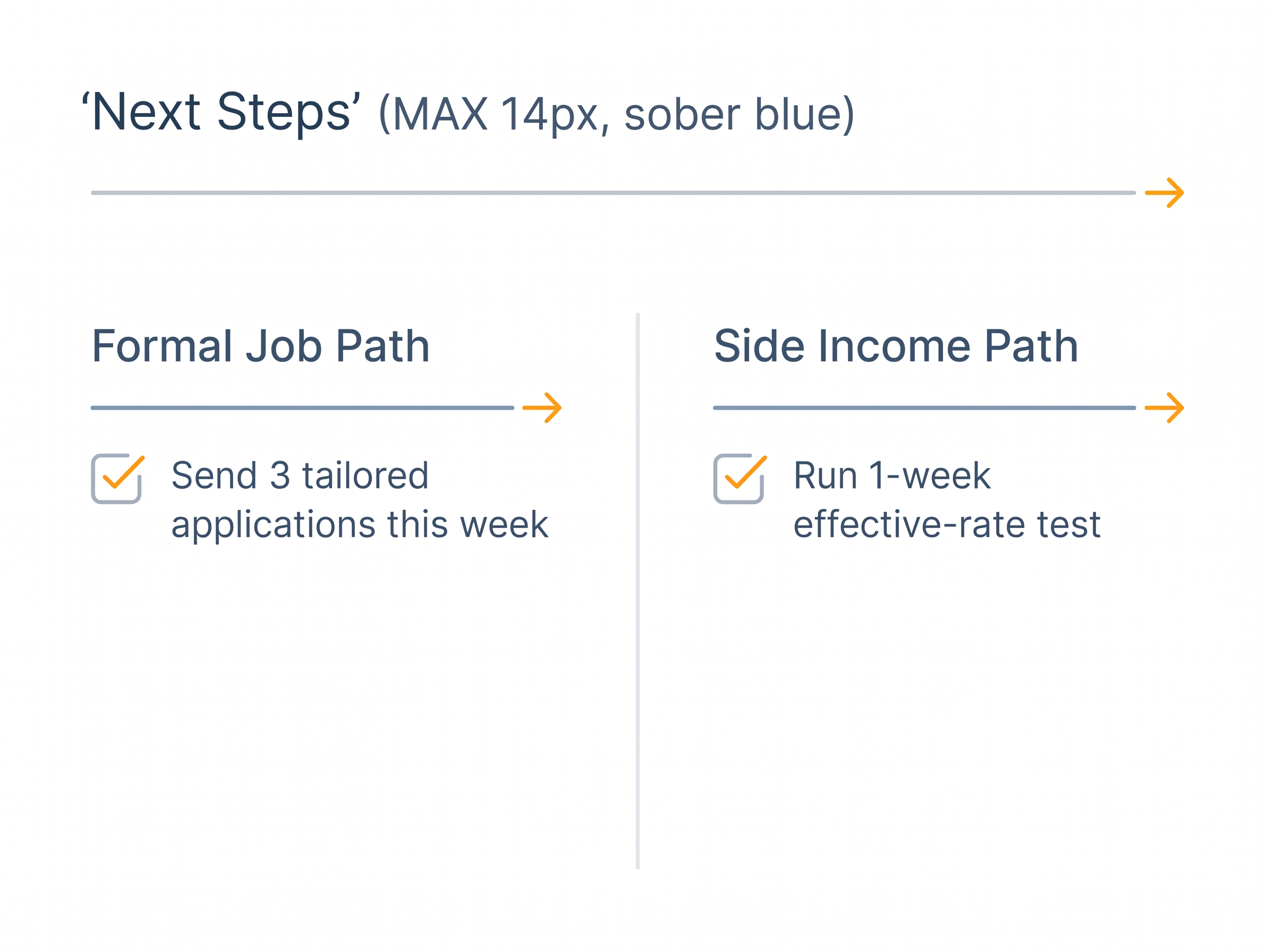
Your next step: send three tailored applications for entry-level support or data roles this week, and, if you want side income in the meantime, run the one-week effective-rate test on a single task platform. When you're ready, see legitimate work-from-home options in action and compare what's available.
You may not need experience to start, but you do need to check every offer carefully to make sure you get paid.
About This Guide
This guide is published by OnlineJobs.
Transparency Statement
This article draws on US government wage data reported through secondary sources, FTC guidance as summarized by JobScamScore, industry and academic guides, a Consumer Federation of America scam-loss report, Zety resume guidance, and OnlineJobs' current site terms. Each source is cited where used. Earnings examples are illustrations, not guarantees. Recheck time-sensitive figures against original sources.
References
[1] 30+ Remote Work Statistics in the U.S. & Globally (2025–2026)
[2] 25 Remote Jobs, No Experience Needed, & Companies
[3] 25 Job Scam Red Flags (FTC-Backed List) + Free Checker — 2026 | JobScamScore
[4] 15 Best Remote Jobs With No Experience for Beginners | Remote Nomad Jobs
[5] Work-From-Home Resume Sample & Writing Guide
[6] Best Microtask Sites: 10 Legit Platforms to Earn | EarnLab
[7] 15 Best Remote Jobs With No Experience for Beginners | Remote Nomad Jobs
[8] Amazon Mechanical Turk: Closure Dates and Pay — CASRAI
[9] Empowering the Crowd: Measuring the Impact of AI-Driven Tools on Crowdwork | IntechOpen
[10] [PDF] The Scam Economy: - Consumer Federation of America