 OnlineJobs
Key takeaway: Micro task jobs are short online assignments such as surveys, image tagging, app testing, data entry, and product feedback. Each one pays a small amount when completed. Treat them as flexible extra income, not guaranteed full-time work. In 2026, what matters most is choosing legitimate platforms, calculating your real hourly rate, protecting your approval record, and never paying money to unlock earnings.
Micro task jobs are short, repeatable online tasks you complete independently through a website or app. Common examples include surveys, data labeling, transcription snippets, app testing, product categorization, simple data entry, usability feedback, and content moderation. They require no interviews, no formal credentials, and no fixed schedule.
That low barrier appeals to people who want side income on their own terms, often from a phone, between classes, or after a primary job. Results are uneven, though. Task availability depends on your location (including within the US and Europe), your profile, current demand, and your approval history. Two people on the same platform can have very different weeks.
Scale figures are often misused. One industry estimate reported 76.4 million US freelancers in 2025, roughly 36% of the workforce. That figure covers professional freelancing, which is very different from low-barrier microtask work. Policy research makes the distinction clear: platform work includes online freelancing, crowdwork, and microtasks, and these differ substantially in autonomy, earnings, and long-term prospects [8].
This guide skips "easy money" hype and focuses on what actually changes your results:
- earnings math after screening
- the scam patterns the FTC has warned about
- what the reported August 2026 Mechanical Turk closure means
- how PayPal and crypto payouts compare
- how beginners can protect their approval rate
Before you join any platform, work out what the tasks will actually pay once you account for time, screen-outs, and rejections.
What workers say
"Doing online tasks for money won't make you rich" — Money Making Mommy, practitioner perspective.
"Micro jobs are quick odd jobs that can be done for pay" — The Work at Home Wife, practitioner perspective.
"Hey guys, I recently came across something called microtasks where you do small online jobs to earn money." — r/sidehustlestack community, Reddit. This beginner question captures the uncertainty many first-time users feel.
Across these communities, people describe microtasks as a source of extra cash rather than a replacement salary. The same concerns come up repeatedly: inconsistent availability, payout thresholds, and scams.
How Much Micro Task Jobs Really Pay After Time and Screening
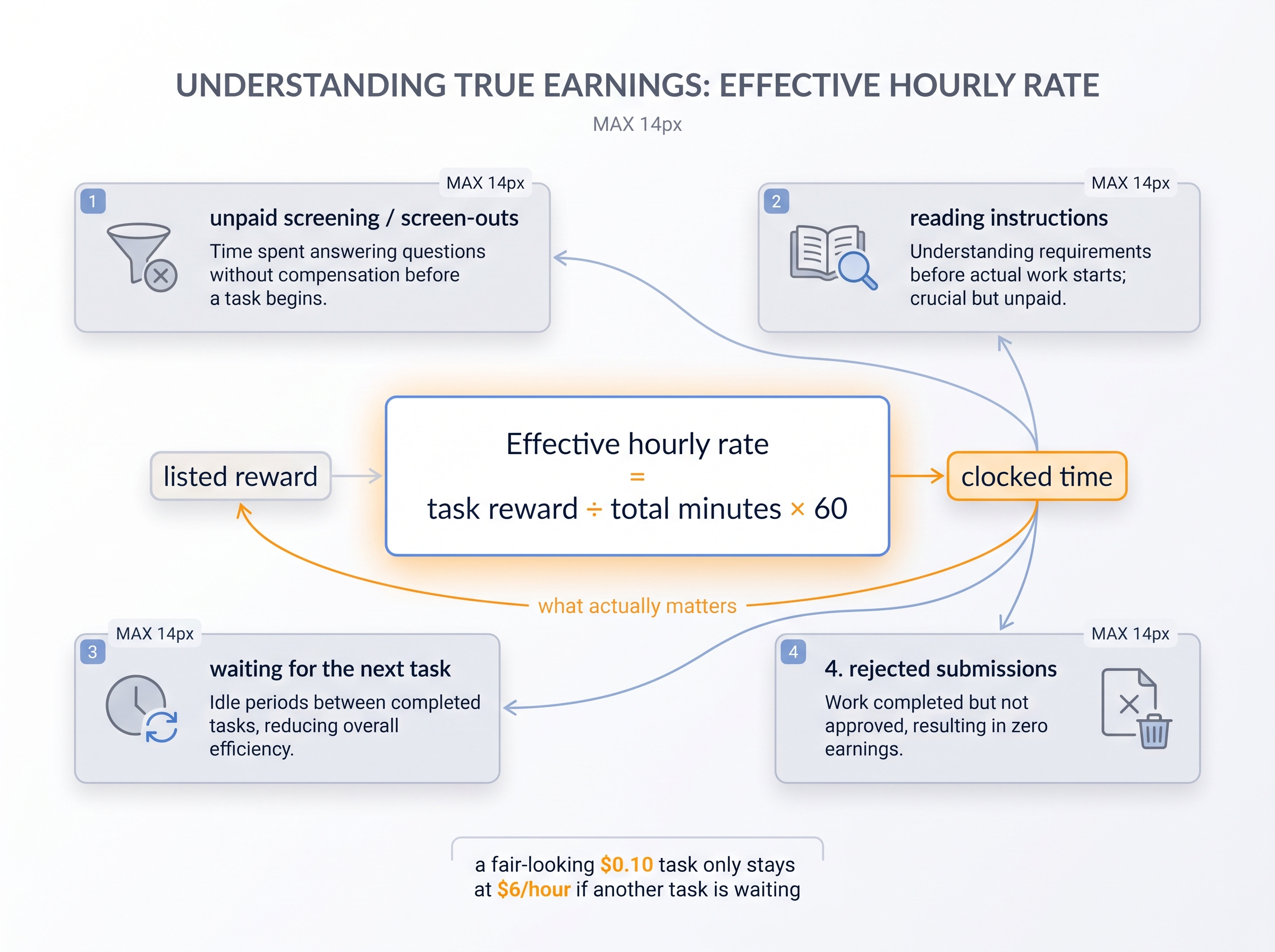
Micro task jobs usually pay per completed task. The listed reward is not the number that matters. What matters is your effective hourly rate once you include unpaid screening, reading instructions, waiting, and rejected submissions.
What micro task jobs include and why pay varies
Three labels often get mixed up:
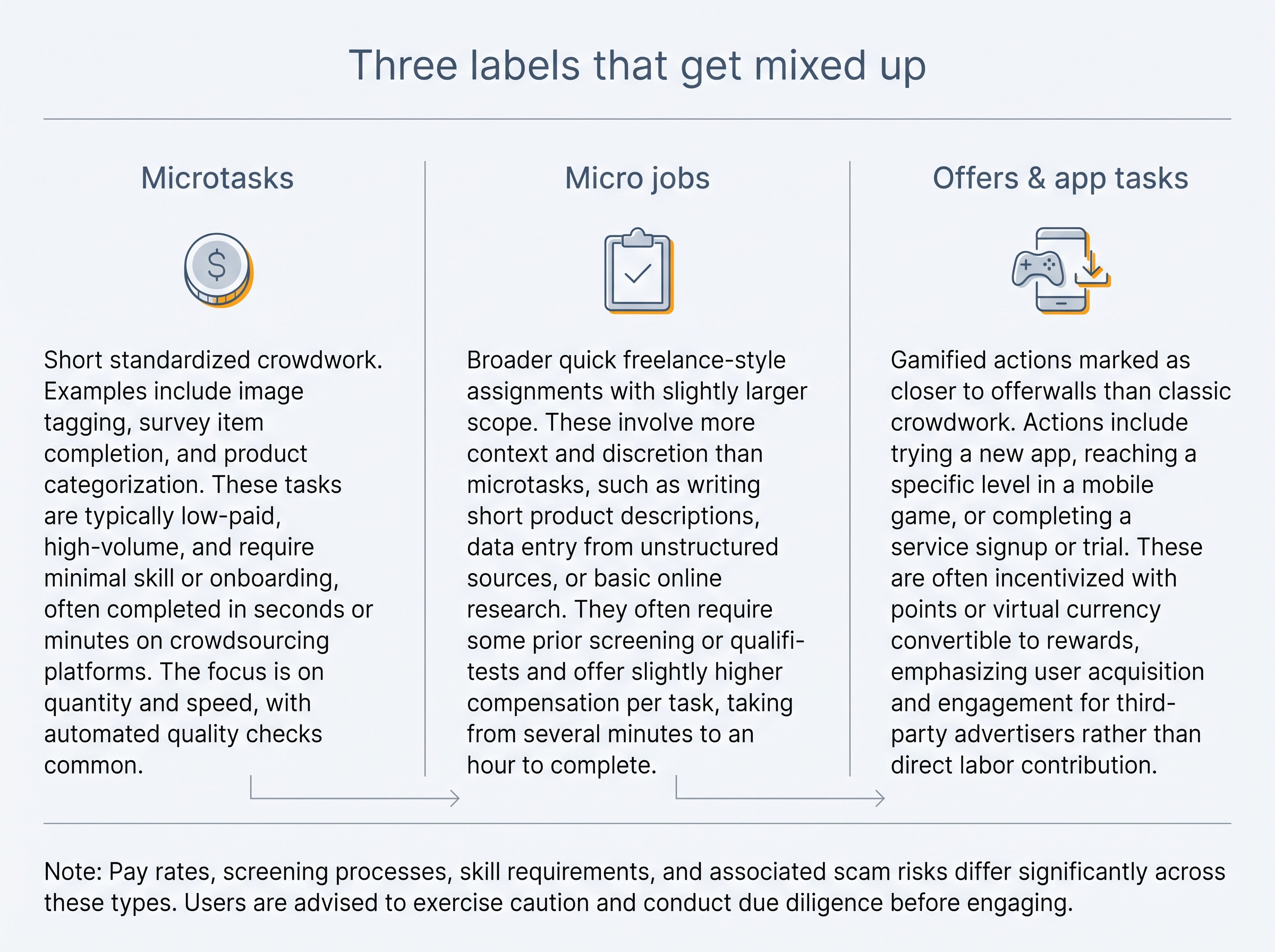
- Microtasks are short, standardized assignments, such as tagging an image, answering a survey, or categorizing a product.
- Micro jobs is a broader term that can include quick freelance-style assignments.
- Offers and app-based tasks involve actions like trying an app, reaching a game level, or completing a signup. These are closer to gamified earning than to classic crowdwork.
Typical work includes:
- Surveys and research studies
- Data labeling and image categorization
- Website or mobile-app testing
- Short transcription or content-review tasks
- Product feedback
- Simple administrative and data-entry work
According to one secondary industry source, many individual microtasks pay roughly $0.02 to $0.50 and often take less than a minute each [9]. Rates vary with task complexity, your location, and your qualifications. OnlineJobs may advertise offers worth up to $5. Treat that as a ceiling for a single offer, not a standard hourly rate or a guarantee.
Calculate the effective hourly rate before accepting a task
Effective hourly rate = task reward ÷ total minutes spent × 60 Count the full time: reading instructions, answering qualification questions, completing the task, capturing screenshots or proof, and submitting.
The examples below are illustrations only, not platform earnings data:
| Example | Reward | Total time | Effective hourly rate | Important caveat |
|---|---|---|---|---|
| Quick categorization task | $0.10 | 1 minute | $6.00/hour | Only accurate if similar tasks remain available |
| Survey with screening | $1.00 | 12 minutes | $5.00/hour | Include unpaid screen-outs |
| Offer completion | $5.00 | 45 minutes | $6.67/hour | Check all completion requirements first |
Use research benchmarks without treating them as promises
In one academic study of crowdwork, MTurk workers reported targeting about $13 per hour on average, while Prolific workers targeted about $10.50 per hour. Practitioner testing has also discussed an $8 per hour minimum on Prolific. These are reference points, not offers:
| Research reference | Reported worker target/standard | How to interpret it |
|---|---|---|
| MTurk workers in an academic study | About $13/hour target | A worker target, not a guaranteed platform-wide wage |
| Prolific workers in the same study | About $10.50/hour target | A benchmark from a specific research context |
| Prolific minimum discussed in practitioner testing | $8/hour minimum | Verify current platform terms before relying on it |
Don't apply these figures to every platform, every worker, or every hour. Research into crowdwork conditions shows that pay rates, work availability, and work intensity vary enough to change outcomes dramatically [3]. A shortage of tasks can drag your earnings down even when each individual task looks fair. A $0.10 task that works out to $6 per hour only keeps paying that rate if another task is waiting when you finish.
Stakes matter too. Research on digital labor platforms found that 37% of workers rely on crowd work as their primary source of income [2]. If you are considering doing the same, track at least a month of real earnings before reducing any other income.
A low-paying task is disappointing. A platform that asks you to pay before you can withdraw is a much more serious warning sign.
How to Identify Task Scams Before You Lose Money
A legitimate microtask site may ask you to verify your identity or complete work. It should never require a crypto deposit, a fee, or a transfer to unlock wages you have already earned.
Recognize the FTC-flagged task scam pattern
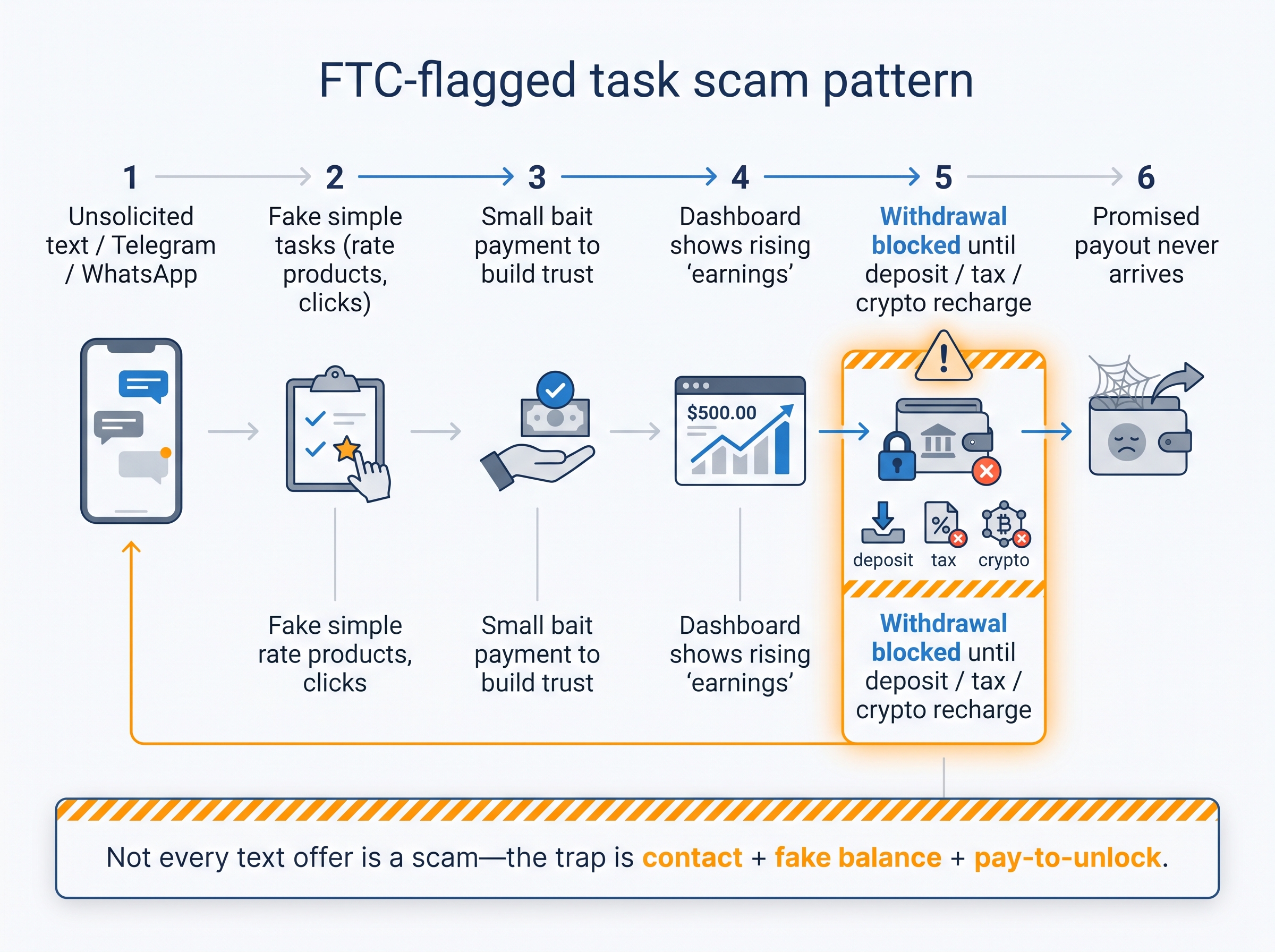
Consumer reporting on FTC warnings describes a repeatable sequence [7]:
- You receive an unexpected text, Telegram, or WhatsApp message offering easy online work.
- You are asked to rate products, "optimize" apps, complete clicks, or perform other simple "tasks."
- The scammer may send a small initial payment to build trust.
- A dashboard shows your "earnings" growing.
- When you try to withdraw, you are told to pay a deposit, tax, recharge, verification fee, or cryptocurrency transfer first.
The promised payouts never arrive. Not every job offer sent by text is fraudulent. The danger lies in the combination: unsolicited contact, a fake balance, and a demand for payment.
A reported withdrawal-trap example
A third-party reviewer reported testing an unnamed "Platform A" for 30 days. The account allegedly showed $47 in accumulated earnings. When the reviewer tried to withdraw, the platform demanded a $25 "verification fee" first. We cannot independently verify this account, but the mechanism is what matters. Charging a fee to release wages is inconsistent with how legitimate contractor and reward platforms handle payments. Real platforms pay you. They do not invoice you.
⚠️ If they invoice you, walk away
Identity checks and withdrawal minimums can be legitimate. A deposit, VIP upgrade, 'verification fee,' tax, or crypto recharge to unlock wages you already earned is not. Stop, do not pay, and consider reporting the site to your payment provider and a consumer-protection authority.
The five-point legitimacy checklist
Run through this list before registering:
- Check the official domain. Don't click links from unsolicited messages. Type the platform name into your browser yourself.
- Read the payout rules first. Note the minimum withdrawal, payment methods, verification process, and payment timeline.
- Never pay to receive money. That includes deposits, "VIP upgrades," crypto recharges, withdrawal taxes, and verification fees.
- Search for independent complaints. Try searches such as "can't withdraw," "verification fee," "account frozen," and "task scam" alongside the platform name.
- Limit the personal data you share. Don't upload government ID, bank details, or sensitive documents unless you understand why they are needed and how they will be protected.
The last point is backed by research. A peer-reviewed study of crowdwork tasks found that tasks often request workers' personal information, which raises privacy risks [4]. If a task asks for data unrelated to the work itself, walk away.
Scam awareness matters even more right now, because workers leaving older platforms are actively searching for replacements.
What the Amazon Mechanical Turk Closure Means for Microtask Workers
Amazon Mechanical Turk's reported closure in August 2026 changed the landscape, but it did not end microtask work. It did make platform selection, payment transparency, and task-quality checks more important.
Why Mechanical Turk mattered
| Date | Development | Why it matters to readers |
|---|---|---|
| Late 2005 | Amazon Mechanical Turk launched | Helped establish online crowdwork at scale |
| 2005–2026 | Tasks included surveys, data collection, AI training, moderation, and other data work | Shows the breadth of work commonly called microtasks |
| August 2026 | Reported shutdown | Workers and requesters began seeking alternatives |
TechPolicy.Press reports that MTurk launched in late 2005 as a marketplace where "requesters" could post work for approved workers. Tasks ranged from surveys and data collection to AI training, content moderation, and government work [6]. Business Insider reported that workers could be paid as little as a few cents per task, even though many valued the flexibility to work where and when they wanted [5]. MTurk largely defined the category. Its exit leaves a gap, along with a lot of outdated "best sites" lists.
What changes and what doesn't
What changed: A legacy marketplace is no longer the default recommendation for new microtask workers.
What didn't change: Businesses still need human input for data quality, usability testing, surveys, content review, and app feedback. The demand is still there.
What you shouldn't assume: One platform closing does not make every alternative safer, better paid, or available in your country. The market is also hard to measure. The ILO notes that most digital labor platforms do not publicly disclose how many active workers they have, so estimates rely on surveys and available statistical data [1]. Treat precise worker counts as estimates at best.
A practical migration path for former MTurk users
- List the work types you completed successfully, such as surveys, tagging, transcription, testing, or moderation.
- Prioritize platforms that disclose payment methods, approval processes, and payout thresholds before you sign up.
- Start with low-risk tasks so you can learn each platform's instructions and rating standards.
- Track your time, rejection rate, and cash-out reliability for two weeks before committing significant time.
For a sense of scale, Microworkers reported more than 4,560,439 workers worldwide in a December 2025 company post. That is a company-reported count of its global community, not an independently audited number of active users. Read it as marketing context rather than proof that work is available.
Once you have found legitimate alternatives, the next step is deciding how you want to receive and protect your earnings.
Compare PayPal, Bitcoin, Ethereum, and Other Microtask Payout Options
The best payout method depends on how quickly you need cash, the withdrawal threshold, fees, availability in your location, and how comfortable you are managing crypto safely.
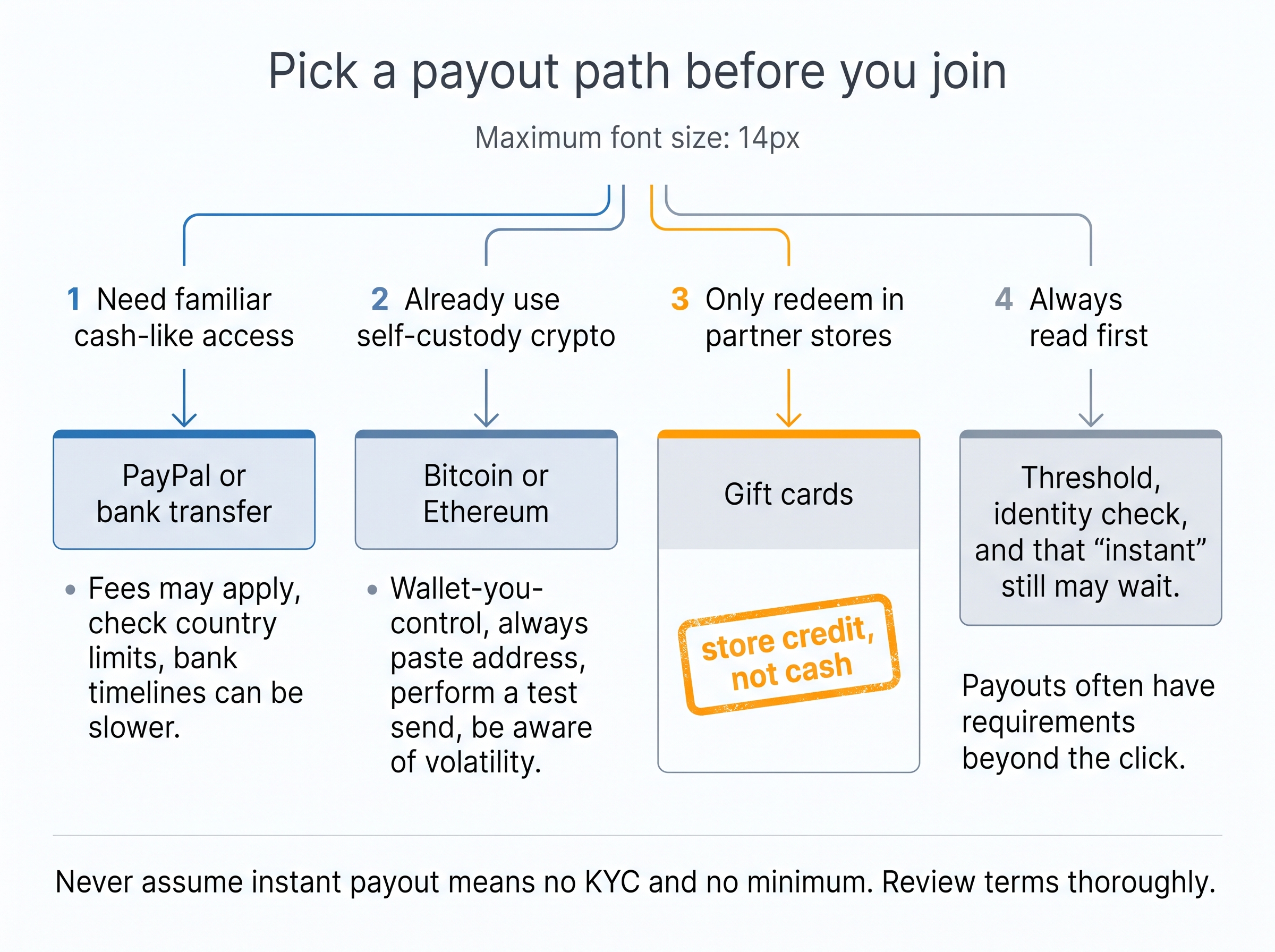
Compare payout methods before joining a platform
| Payout method | Best for | Main benefit | Main limitation | Reader guidance |
|---|---|---|---|---|
| PayPal | Users who want familiar online payments | Widely recognized and easy to use | Fees, country restrictions, or withdrawal limits may apply | Review the platform's threshold and PayPal availability |
| Bitcoin | Crypto-comfortable users seeking a decentralized option | Can be transferred to a personal wallet | Price volatility and transaction considerations | Use a wallet you control and verify the receiving address |
| Ethereum | Users already using ETH-compatible wallets | Familiar option for Web3 users | Network fees and volatility can affect value | Confirm whether the platform pays native ETH or another token |
| Bank transfer | Users who prefer conventional cash access | Direct connection to bank funds | May have slower processing or higher thresholds | Confirm region and identity-verification requirements |
| Gift cards | Users who already shop with partner retailers | Simple redemption route | Less flexible than cash | Treat as store credit, not cash earnings |
Gift cards deserve a closer look. Research on digital labor platforms found that on some platforms, workers are not paid in money at all but in gift vouchers, which limits what they can do with their earnings [2]. Also, never assume that "instant payout" means no threshold, no identity check, and no delay. Read the fine print before you work toward a cash-out.
OnlineJobs payout options: Eligible users may be able to redeem earnings through Bitcoin, Ethereum, or PayPal, depending on account eligibility, location, and offer terms at the time. Check the current redemption rules inside the platform before completing an offer.
A safety checklist for your first crypto payout
- Create a wallet with a reputable provider and store its recovery phrase offline.
- Copy and paste the wallet address directly. Never type it by hand.
- Send or receive a small test amount first if the platform allows it.
- Remember that crypto values can rise or fall after you are paid, so the cash value of your payout is not fixed.
For a sense of payout options elsewhere, the directory SkipTheDrive reports that Zeerk supports daily withdrawals via PayPal, Wise, Binance, Payoneer, or crypto wallets. This information comes from the directory, so confirm current terms directly before relying on it.
Your payout method determines when you receive money. Your approval record determines whether you keep getting tasks at all.
Protect Your Approval Rate and Reduce Rejection Risk
On many microtask platforms, one rushed submission can cost you more than the task was worth. Your approval history can affect your future access to tasks, your payment timing, and your account standing.
How approval systems work
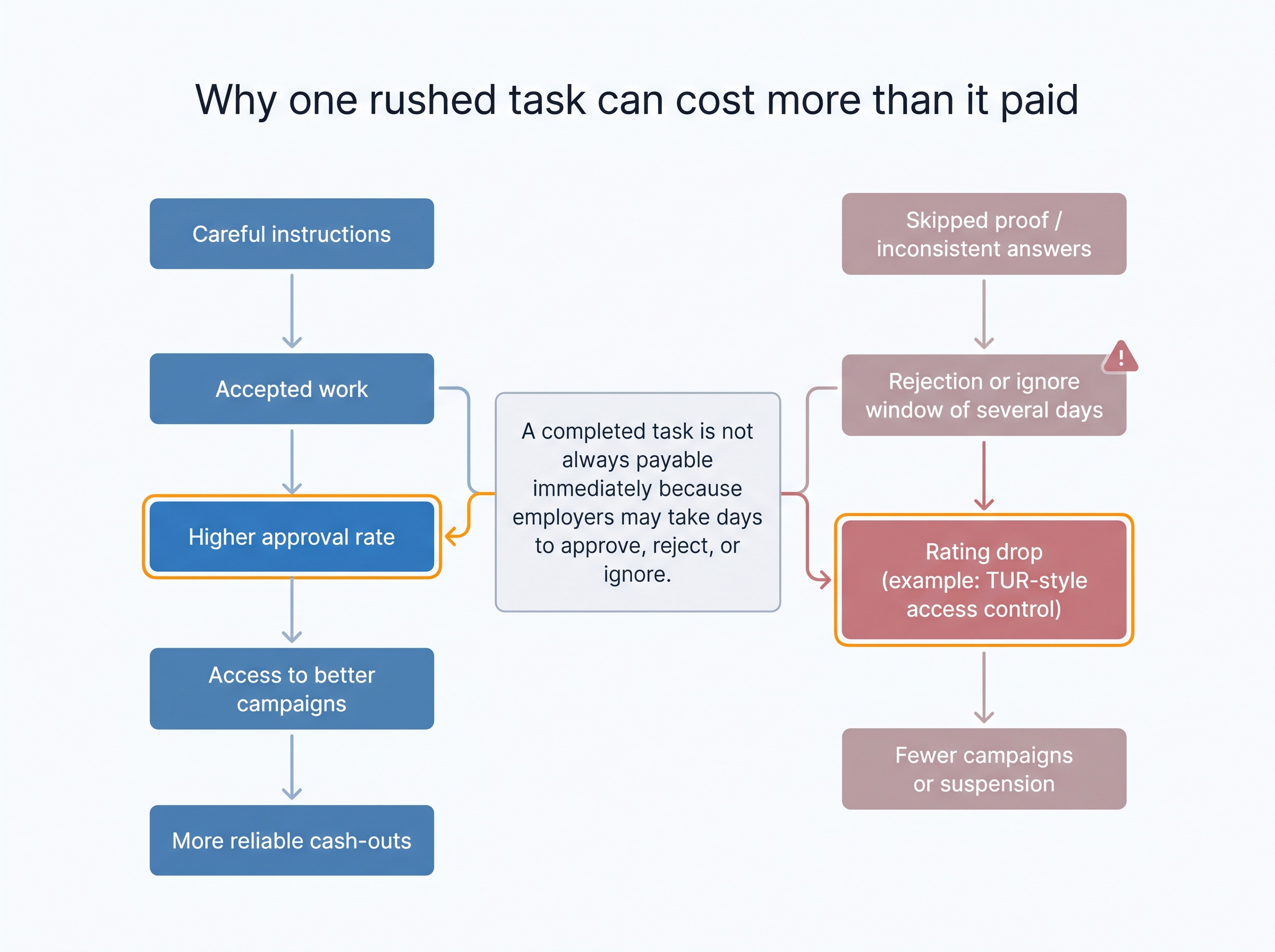
Your approval rate is the percentage of your submitted tasks that requesters or reviewers accept. Many platforms use internal ratings to control access to future work.
A review focused on Microworkers describes its rating system, called TUR (Task Updated Rating). Your approval rate is tracked continuously, it determines which new campaigns you can access, and falling below a certain threshold can lead to account suspension [10]. The same review notes that employers typically have a few days to approve, reject, or ignore your work. That means a completed task is not always payable right away.
A beginner protection workflow
- Start with simple, low-value tasks to learn the proof and submission rules.
- Read the instructions twice before opening external links or submitting anything.
- Save screenshots, confirmation numbers, and timestamps whenever a task requires proof.
- Take your time with qualification questions. Inconsistent answers can disqualify you.
- Keep a spreadsheet with each task's name, reward, start time, completion time, submission date, and status.
- If similar tasks keep getting rejected, stop accepting them until you understand why.
The spreadsheet is tedious, but it is the only reliable way to learn your real numbers.
The non-payment and privacy tradeoff
Crowdwork research has identified work availability, work intensity, rejections, and non-payment as core issues affecting working conditions on microtask platforms [3]. Rejection without explanation is a known, widespread frustration, so don't treat it as a personal failure.
Privacy is the other half of the tradeoff, because tasks may request personal information in ways that create real risk [4]. Using a dedicated email address can help where appropriate. However, never create multiple accounts on a platform that prohibits it. That shortcut gets accounts closed.
Move on from a platform when:
- its payout rules are unclear
- rejections come with no explanation
- its requests for information become invasive
- tasks consistently take longer than promised
- it asks you to pay money to continue
With realistic expectations, safe payout habits, and a protected approval record, beginners can test microtask work without counting on it as a guaranteed income source.
Frequently Asked Questions
What are micro task jobs?
Micro task jobs are small online assignments that pay per completed task rather than a salary. Examples include taking surveys, testing apps, tagging images, categorizing information, entering data, and giving product feedback. They are usually flexible and beginner-friendly. How much work is available, and how well it pays, depends on the platform, your location, your profile, and your approval history.
How much can I realistically earn from microtasks per hour?
Your real hourly earnings depend on task pay, total time spent, unpaid screen-outs, and whether your work is approved. Research-based worker targets such as $10.50 or $13 per hour are benchmarks, not promises. Track every task for a week, including time spent qualifying, to see whether a platform is worth continuing.
Are microtask sites legitimate?
Some are legitimate, but legitimacy varies by platform and by task. Look for transparent payout terms, clear contact information, independent reviews, and rules that never require deposits. A legitimate platform may verify your identity. It should not demand money, cryptocurrency, or paid upgrades before you can withdraw rewards you have earned.
What is a task scam?
A task scam is a fake online-work scheme that shows your earnings growing and then asks you to pay to unlock them. These scams often start with unsolicited text or WhatsApp messages and may make a small initial payment to gain your trust. Never pay a "verification fee," "tax," "recharge," or crypto deposit to receive wages.
Which microtask platforms have low payout thresholds?
Low thresholds make it easier to test whether a platform actually pays, but they don't guarantee a better experience. Before starting, check the withdrawal minimum, fees, identity requirements, and processing time. A platform with a slightly higher threshold can still be the better choice if its tasks pay fairly and its rules are clear.
Can I get paid in Bitcoin or Ethereum for microtasks?
Some reward platforms offer Bitcoin or Ethereum payouts, depending on your country, your account, and current redemption rules. Use a wallet you control, protect your recovery phrase, and double-check the receiving address. Cryptocurrency values can change after you are paid, so the cash value is not guaranteed.
What happened to Amazon Mechanical Turk?
Amazon Mechanical Turk reportedly shut down in August 2026 after operating as a major crowdwork marketplace since 2005. Older articles and AI-generated lists may still recommend it. Evaluate current platforms individually rather than assuming any service is a direct replacement for MTurk.
Do I need experience to start micro task jobs?
Most entry-level microtask work requires no formal experience, but accuracy and careful instruction-following matter. Start with simple tasks, document your submissions, and build a strong approval record before moving on to harder offers. If a task requires specialized skills, asks for personal financial information, or demands an upfront payment, stop and assess it carefully.
Limits, Alternatives, and When to Seek Professional Help
Micro task jobs can add flexible extra income, but they cannot replace a predictable wage, benefits, or long-term career development. Your income will fluctuate with task availability, eligibility, approvals, and payout policies. If you want steadier remote work, consider customer support, entry-level admin roles, data-entry jobs, freelance services, or other skills-based online work.
If a platform withholds your money, asks for a deposit, or requests sensitive information, stop using it. Consider reporting it to your payment provider and to a consumer-protection authority. For questions about taxes, debt, or investments related to your earnings or crypto, consult a qualified professional. This guide is general information, not financial, tax, or legal advice.
Conclusion
Micro task jobs can be a practical way to earn extra money from short online assignments, especially if you value flexibility and don't have formal experience. To get the most from them:
- Measure your real rate. Track the full time each task takes, not just the advertised reward.
- Vet before you work. Choose platforms with transparent rules and read the payout requirements before investing any time.
- Guard your record. Protect your approval rate by reading instructions carefully and keeping proof of your work.
- Refuse upfront payments. Treat any request for money as a red flag, no matter how it is described.
After the 2026 Mechanical Turk closure, outdated recommendations carry more risk than ever. Instead of chasing exaggerated income claims, try one legitimate platform for a week. Complete a few tasks, record your effective hourly rate, and cash out as soon as you reach the published threshold. Successfully receiving a payout is the best test of whether a platform deserves more of your time.
Ready to explore more vetted remote earning options? See legitimate work-from-home jobs in action at OnlineJobs' legitimate work-from-home guide.
About OnlineJobs
We're the OnlineJobs team. We write about what we know best, aiming to explain it clearly and help you decide with information you can trust.
Transparency Statement
This guide cites academic research, institutional reports, consumer-protection reporting, platform documentation, independent reviews, and community discussions, all listed below. OnlineJobs may benefit when readers use its platform. This article does not guarantee earnings, task availability, approval, or payout eligibility.
References
[3] (PDF) The platform as factory: Crowdwork and the hidden
[4] Investigating the Accessibility of Crowdwork Tasks on
[5] Amazon Shutters Mechanical Turk Amid Rise of AI-Driven Tasks - Business Insider
[6] Mechanical Turk is Closing. The Workers Who Built AI Are Still Here | TechPolicy.Press
[7] Employment scams are surging. Here's how to recognize the most common schemes
[8] Global Standards, Local Realities
[9] Best Microtask Sites 2026: 12 Legit Platforms to Earn Money | EarnLab
[10] Microworkers review: how does it hold up from France in 2026?