 OnlineJobs
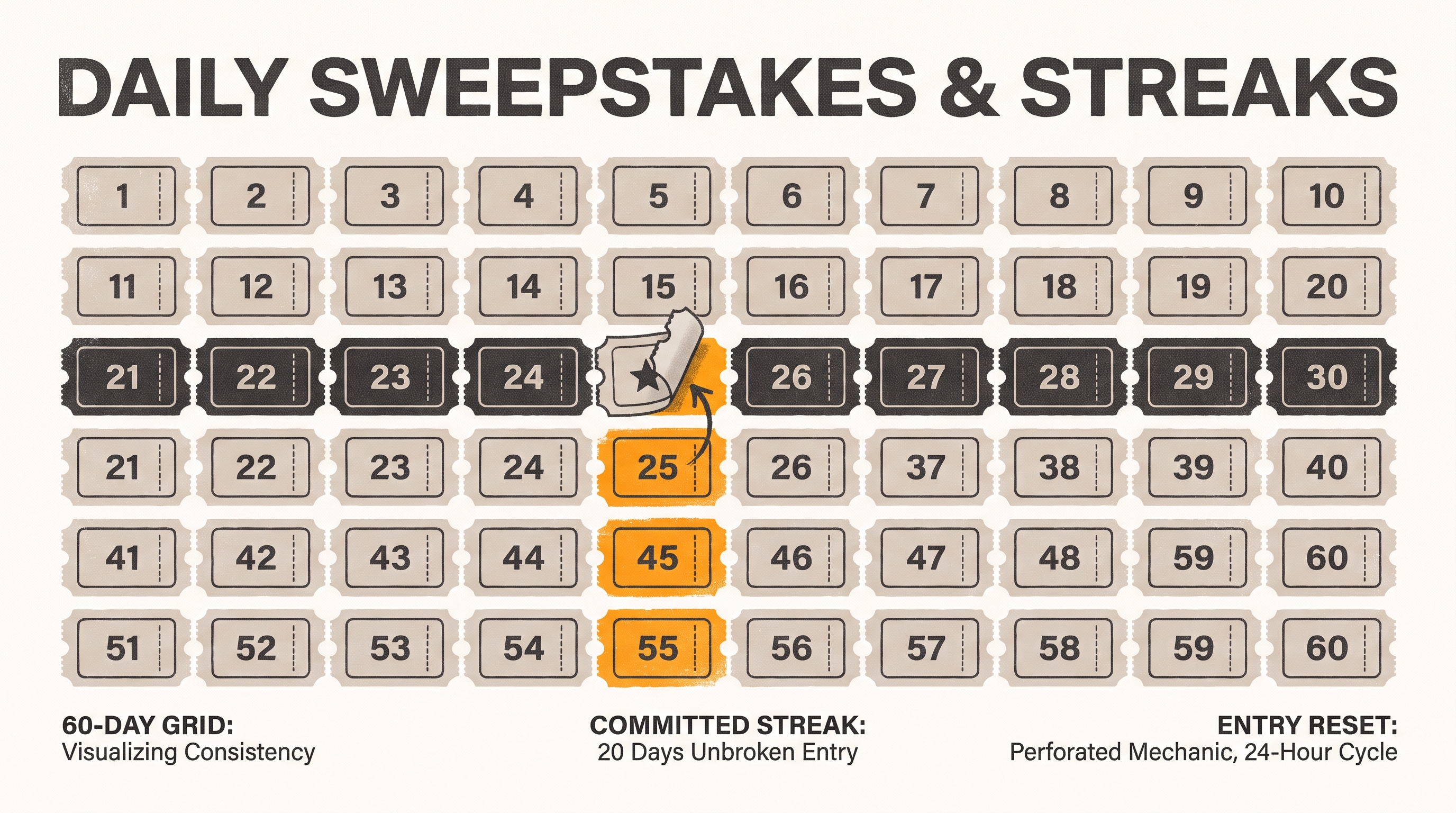
Quick answer: Daily sweepstakes are prize promotions that let you enter once per 24-hour period until the closing date. In the US they must be free to enter — a promotion combining a prize, chance and a required payment is an illegal lottery [7]. Because every day is a fresh entry, consistency is the only variable you control. Keep a short list of legitimate promotions, enter them at the same time each day, never pay for an entry, and protect any streak a platform rewards.
What Are Daily Sweepstakes?
A daily sweepstakes is a prize draw that resets your entry eligibility every 24 hours. You get one shot per day until the end date — some run a week, others run months. The prize is awarded by chance, and a free entry route has to exist.
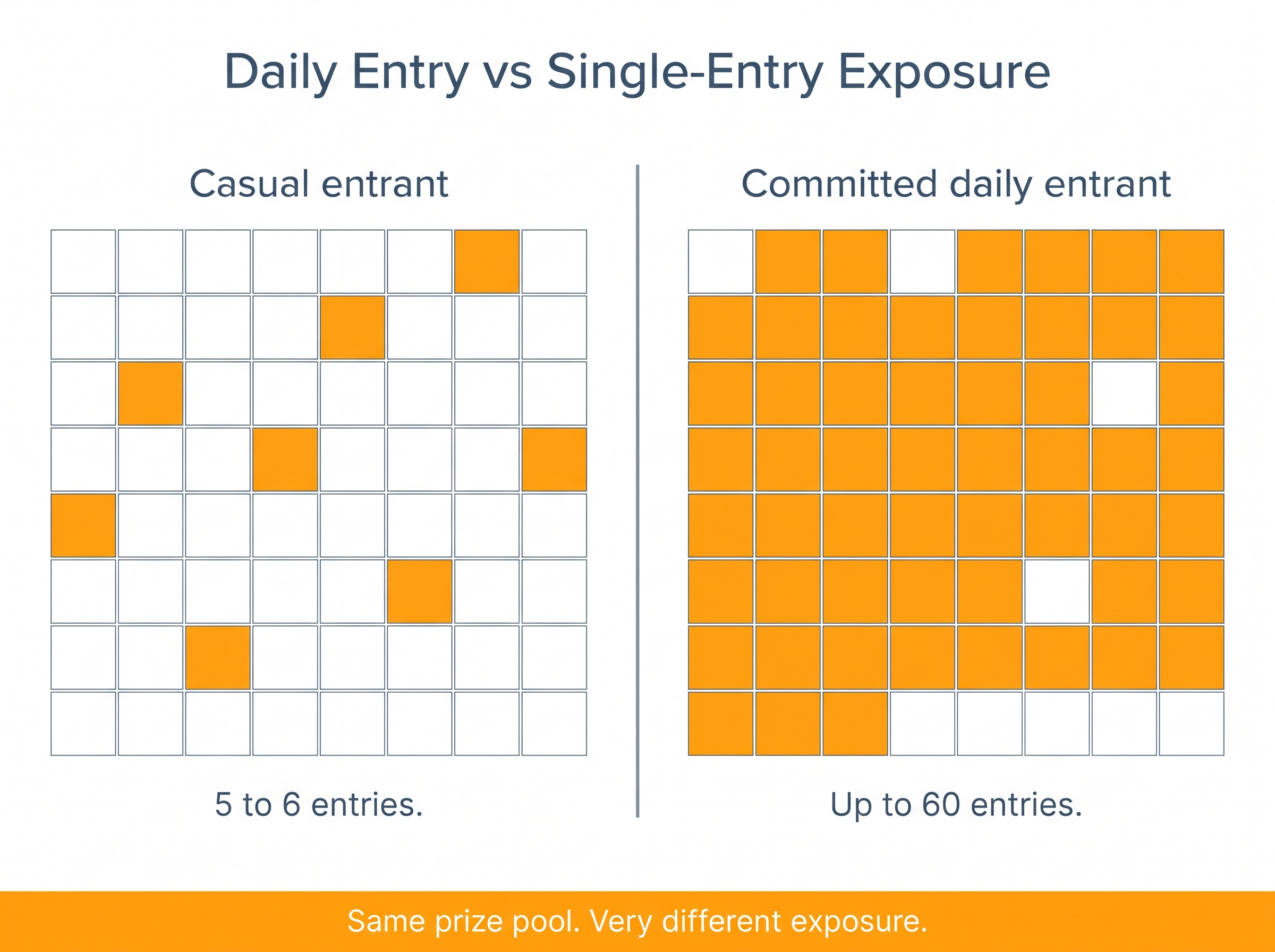
The mechanic matters more than it looks. In a single-entry promotion your odds lock in the moment you submit. In a daily format, every skipped day is a slot someone else filled. A 60-day promotion gives a committed entrant up to 60 entries; a casual one might collect five or six. Same prize pool, very different exposure.
Daily sweepstakes usually come in four shapes:
- Brand promotions. Consumer companies run these to pull repeat visits to a site or app — snack brands, beverage companies, retailers, streaming services.
- Instant-win games with daily plays. Spin a wheel, scratch a virtual card, match symbols. One play per day, prizes from coupons to cash.
- Sweepstakes casinos and social gaming apps. Daily login bonuses and free coin drops, built around sweepstakes law with a no-purchase entry route [6].
- Newsletter and app draws. Sign up once, then confirm your entry each day by opening an email or tapping a button.
The format is big business. The global online sweepstakes platform market was valued at USD 127.1 million in 2025 and is projected to reach USD 219.2 million by 2035, a 5.6% compound annual growth rate [9]. Brands keep funding these promotions because they work — which means a steady supply for anyone willing to show up daily.
Why Daily Entry Sweepstakes Are Worth Your Time
No single entry is likely to win. That is the nature of a chance promotion, and anyone promising otherwise is selling something. What daily formats reward is a behavior most people can't sustain: showing up.
The field is wider than it feels and softer than it looks. Giveaway participation skews toward women, urban residents and working professionals [10] — people fitting entries around jobs and commutes. Most of them fade inside the first week. That is the opening.
Consistent entrants aren't luckier. They're more systematic. They treat entry as a habit stack, the way they'd handle a daily walk or a language-app streak, and the compounding does the rest.
Some formats pay for consistency directly. Many sweepstakes casino operators run tiered daily login bonuses that scale upward with consecutive check-ins; miss one day and your progress resets to the baseline tier [6]. A free-to-enter system that rewards attendance is rare, and worth protecting with an alarm.
Daily entry also fits a side-income stack better than most habits. Entries take 30 seconds to two minutes on a phone — a commute, a lunch break, a coffee queue. No schedule to negotiate, no client to please, no skill threshold. If you already earn through apps and gig platforms, this slots into the existing routine instead of replacing it. Wins typically pay out as digital gift cards, PayPal or in-app credits.
How Daily Entry Odds Actually Work
Daily entry does not make a long shot likely. It makes it measurably less unlikely — and the size of that shift is worth understanding before you spend months on it.
Take an illustrative instant-win promotion averaging 50,000 entries a day that awards one prize daily, with the entry pool held roughly flat. A single entry gives you a 1-in-50,000 chance that day, or 0.002%. Enter all 90 days and your chance of winning at least once is roughly 0.18% — about 1 in 556. The casual entrant who enters five times holds roughly 0.01%, or 1 in 10,000.
That is the whole argument in one comparison: 90 entries instead of five, for maybe two minutes a day. The numbers stay small. But they are 18 times larger than the casual effort, and that ratio — not the absolute probability — is what separates the people who eventually post a win from the people who quit in week two.
Field size matters more than the prize headline. A daily prize contested by 50,000 entries is a better use of two minutes than a house draw with millions of entries and a car on the poster. Check how many entries a promotion absorbs per day before you commit.
One number you'll see repeated everywhere — "about 55 million Americans enter sweepstakes every year" — deserves a caveat. It still appears in current coverage [8], but it traces back to Roper survey data cited in 1998 Congressional testimony, not to a fresh count of today's entrants. Treat it as a historical order-of-magnitude estimate rather than a current statistic.
The Best Times of Day to Enter Daily Sweepstakes
Timing won't bend random odds in a fair draw. It changes whether you enter at all, and that is where most routines die.
Mornings work because willpower and free time both degrade as the day runs. Entering with your coffee means the task is finished before work, notifications and fatigue pile up. Skip the morning and the entry starts competing with everything else on your calendar.
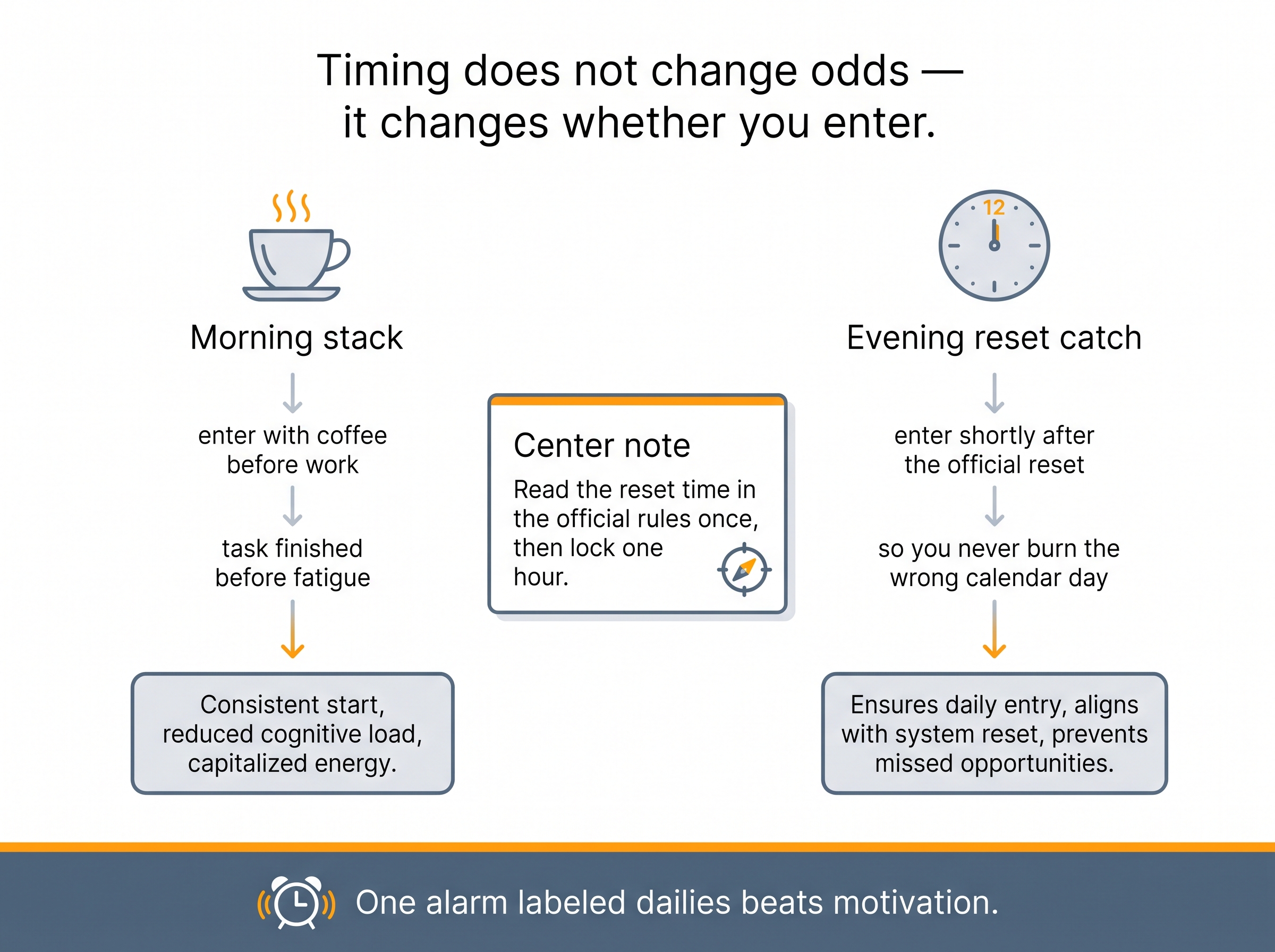
Evenings solve a different problem. Some instant-win promotions reset at midnight in a stated time zone, and entering shortly after the reset means you never burn an entry on the wrong calendar day. US promotions often reset overnight for European readers; the official rules state the reset time, so read it once and build your schedule around it.
Whatever hour you choose, the pattern holds: reminders beat motivation. Digital calendars, alarms and tracking apps all do the same job, and setting one prevents missed entries while keeping timing from becoming a source of stress [5]. Pick a single trigger. An alarm labeled "dailies" at 8 AM is enough.
Organization is the other half. A spreadsheet or notes app listing active promotions, end dates and daily reset times turns a scattered habit into a system; timing alone can't lift your odds if the routine around it has no structure [5]. Ten minutes of setup buys months of autopilot.
How to Build a Daily Sweepstakes Routine That Sticks
Here is a routine that runs about 15 minutes a day. Adjust the list size, keep the shape.
Step 1: Build the list
Start with five to ten active daily promotions. More than that and the routine turns into a chore; fewer and your daily volume is too thin to matter. Bookmark each entry page in a dedicated browser folder.
Step 2: Anchor it to an existing habit
Attach entries to something you already do daily — coffee, lunch, the train home. Habit stacking works because the existing behavior triggers the new one without spending willpower.
Step 3: Set one reminder
A recurring phone alarm or calendar event. As the team at Keep the Sweep puts it, a reminder prevents missed opportunities and keeps timing working in your favor instead of turning into a source of stress [5].
Step 4: Track the streaks that pay
On sweepstakes casinos and apps with tiered login bonuses, a missed day resets progress to the baseline tier [6]. Keep the alarm running so you never leave that value on the table.
Step 5: Prune weekly
Promotions end and new ones launch. Five minutes each weekend removing dead listings and adding replacements keeps the list at fighting weight.
Step 6: Use autofill carefully
Browser autofill cuts entry time sharply. Verify every field before submitting, especially date of birth, state and email — a wrong entry there can disqualify a win you never hear about.
Make entering easier than skipping, and entries accumulate whether or not you feel motivated.
Where to Find Legitimate Daily Sweepstakes
Finding promotions is less of a problem than filtering them. They scatter across brand sites, social feeds, apps and newsletters, and quality varies enormously.
Sweepstakes directories and aggregators
Aggregator sites index active promotions in a searchable format. Treat directories as starting points, not endorsements. Much of the content is scraped rather than editorially vetted, so click through and read the official rules on the sponsor's own domain before entering. If the rules page doesn't exist or looks thrown together, walk away.
Brand websites and apps directly
Large consumer brands run recurring promotions on their own domains. These are the safest entries available, because the sponsor's identity is unambiguous and the rules sit on the same site that sells the product.
Curated newsletters
The good ones do the filtering that directories skip: a human checks the prize, the end date and the entry limit, and flags anything that looks off.
Brands you already buy, on social
Plenty of daily-entry promotions are announced on Instagram, Facebook or X before anywhere else. Following a handful of brands in categories you like surfaces them early, and in a daily format early entry means more total entries.
Sweepstakes casino platforms
If you go this route, understand the free-entry structure first. Legitimate operators publish an alternative method of entry, often a mail-in request card, that requires no purchase [6]. It exists because the law demands it. Platform rules vary by state and have shifted in recent years, so confirm your state's current position before depositing.
Whatever the source, run the same five-point check:
- Entry is free, with a stated no-purchase route.
- Official rules are published on the sponsor's own domain.
- The sponsor is identifiable and reachable.
- A closing date and draw date are given.
- Eligibility includes the country, state or region you live in.
Thirty seconds per promotion, and that list filters out nearly everything that would waste your time.
Daily Sweepstakes and the Law: What "No Purchase Necessary" Really Means
Safe entry comes down to one phrase, and why it exists.
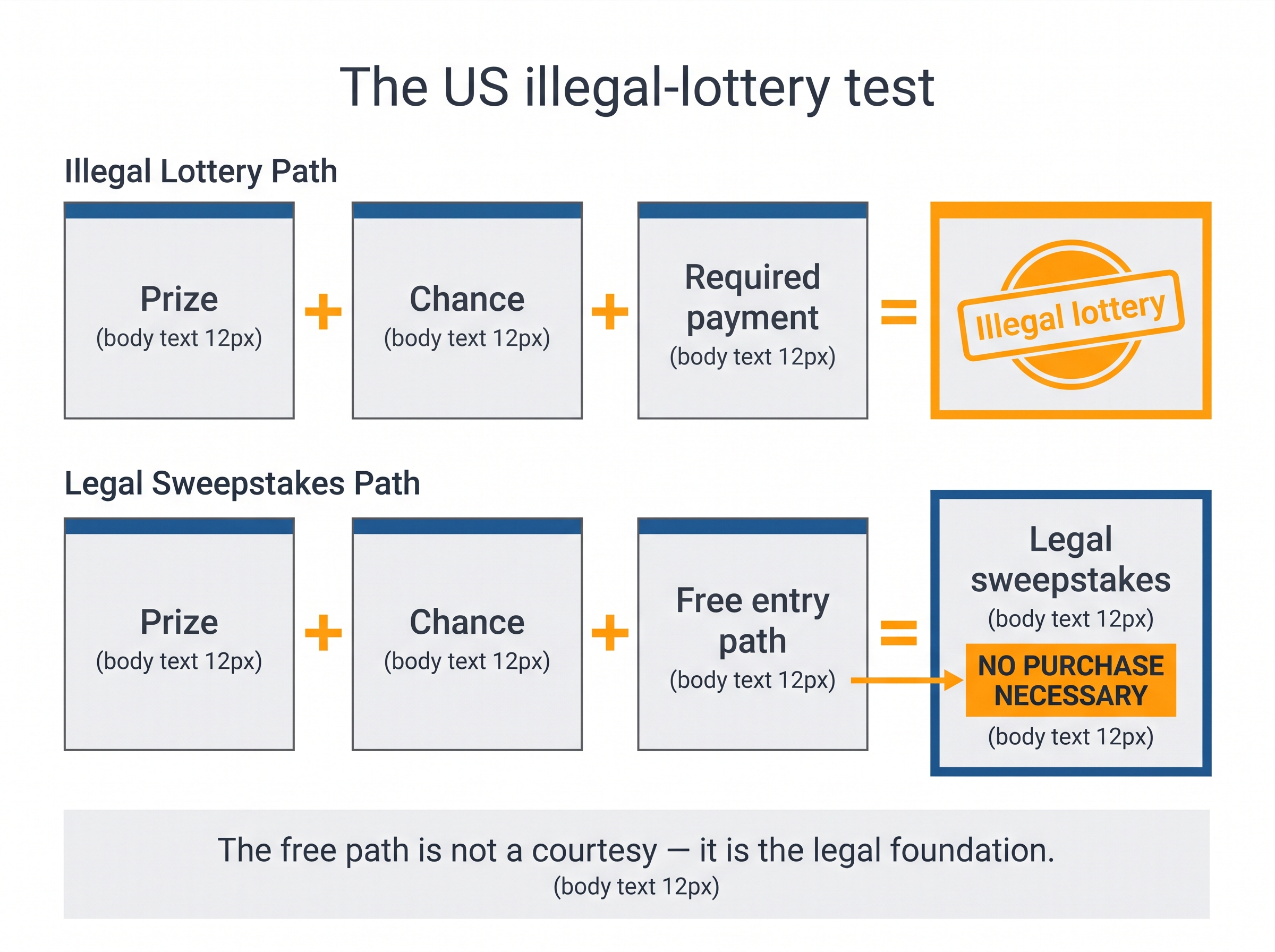
In the United States, a promotion combining a prize, chance and required payment is treated as an illegal lottery [7]. Lotteries are reserved to the states. For a private company to run a chance-based promotion legally, it has to remove the payment element — which is exactly what "no purchase necessary" does. The free entry path isn't a courtesy; it's the legal foundation of the whole promotion.
The FTC polices that boundary through Section 5 of the FTC Act, which declares "unfair or deceptive acts or practices in or affecting commerce" unlawful, and its consumer guidance is blunt about the entrant's side: "It's illegal to ask you to pay or buy something to enter or to increase your odds of winning" [1]. Federal law and the laws of all 50 states prohibit requiring a purchase as a condition of entry, and the rule must be disclosed clearly and conspicuously in promotional materials, usually as "NO PURCHASE NECESSARY TO ENTER OR WIN" [2].
This legal map is US-specific. UK and EU prize promotions follow different national rules, but the practical test does not change: never pay to enter or to collect.
What that means in practice:
- A purchase can never improve your odds. A promotion suggesting that buying something boosts your chances is either built illegally or lying to you. Legitimate purchase-with-entry mechanics, such as receipt scanning, must offer a free alternate method of entry on equal terms [7].
- Mail-in entries are legally equal. The alternate method of entry — a mail-in card or an online form — carries the same odds as any paid path. Sponsors cannot quietly disadvantage free entries [6].
- Mail promotions carry extra disclosure duties. Federal law under 39 U.S.C. 3001 requires mailed sweepstakes materials to state that no purchase is necessary [1].
- Sponsors have their own filings. New York requires registration plus a bond or trust account when total prizes exceed $5,000; Florida requires a filing above the same threshold and accepts a trust account, or an exemption for eligible operators, instead of a bond [3]. You don't need to police this yourself, but a major brand that skips the basics is a red flag.
- Nationwide means every state. A promotion open across the US must comply with the rules of each state where entrants live, which is why serious official rules run to several pages [3].
The law sits on your side: a free path in and honest odds. Anything else is a scam wearing a sweepstakes costume.
How to Spot Sweepstakes Scams
This section can save you real money.
Scammers impersonate all kinds of organizations, including reputable charities and well-known sweepstakes brands [4]. The pitch is always some version of "you've won." The trap is always the same: pay to collect.
The FTC states it plainly: "Legitimate sweepstakes are free and by chance. It's illegal to ask you to pay or buy something to enter or to increase your odds of winning. Never pay to get your prize" [4]. Pay, and you lose the money and invite more calls, mail and spam.
Red flags, roughly in the order they show up:
- You won something you never entered. You can't win a draw you didn't enter. If you run dozens of dailies, keep your tracked list handy and check it before you reply.
- Any payment to release a prize. Taxes on real prizes go to the IRS when you file, never to the sponsor up front. "Processing fees," "insurance," "shipping" and "verification fees" are all fiction.
- Gift cards, wire transfers or crypto. These payment rails appear in scam scripts because they're irreversible. No legitimate sponsor uses them.
- Pressure and secrecy. "Act now or forfeit." "Don't tell anyone until the money arrives." Real promotions publish end dates and announce winners publicly.
- Borrowed brand names. Scammers use trusted names because they lower your guard [4]. Verify through the brand's official site, never through the contact details in the message itself.
Two habits worth building. Use a dedicated email address for sweepstakes — it isolates the marketing noise and makes scam mail easier to spot, because you know exactly which address your legitimate entries used. And report anything that asks for money: consumer complaints go to the FTC, and filing one takes a few minutes.
Common Mistakes That Kill Your Chances
Most daily entrants quietly sabotage themselves. These are the recurring ones.
Trusting directories blindly. Aggregated listings get scraped and reposted without curation, so expired promotions, dead links and the occasional fake sit alongside real ones. Verify on the sponsor's page.
Entering once and forgetting. The entire value of a daily format is repetition. One entry in a 90-day promotion is a rounding error. If you can't commit to daily entry, run fewer promotions and actually enter them.
Breaking streaks on tiered bonuses. Where consecutive logins scale rewards upward, a single missed day resets you to baseline [6]. That's free value evaporating for want of an alarm.
Skipping the official rules. The rules carry the entry limit per day, the reset time, the eligibility requirements and the end date. Two minutes of reading prevents disqualifications and wasted months.
Sloppy autofill. A mistyped email or a wrong state can void a winning entry before you know it existed. Check the form before submitting, particularly on a new device.
Paying anything, ever. Worth repeating because it's the only mistake with real financial downside. A payment request means scam [4]. No exceptions.
Frequently Asked Questions
Are daily sweepstakes actually free to enter?
Yes, when they're legitimate. Federal law and the laws of all 50 states prohibit requiring a purchase to enter [2]. Any promotion that demands payment to enter, or to improve your odds, is operating illegally or is an outright scam.
How many daily sweepstakes should I enter?
Five to ten is sustainable for most people, at roughly 15 minutes a day. Volume matters, but consistency matters more — and an oversized list is the main reason routines collapse inside a fortnight.
Does the time of day I enter affect my odds?
Not in a fair random draw. Timing affects whether you enter at all and whether you catch resets correctly. A consistent time backed by a reminder beats any theory about lucky hours [5].
Can I actually win, or is it all marketing?
People do win — sponsors are bound by their published official rules to award the advertised prizes. Odds on any one entry are small; across hundreds of entries a month they improve in proportion. Treat the widely repeated 55-million-Americans figure as a 1998 Congressional estimate, not a current count.
What's the difference between a sweepstakes and a sweepstakes casino?
Brand sweepstakes vs sweepstakes casino
| Option | Pros | Cons |
|---|---|---|
| Traditional brand sweepstakes | Sponsor identity is unambiguous and the official rules sit on the same domain that sells the product — usually the safest entries. | No streak bonuses; a skipped day is simply a lost ticket, with nothing compounding besides raw entry count. |
| Sweepstakes casino / social gaming | Tiered daily login bonuses scale with consecutive check-ins, paying for attendance on top of whatever the draw does. | Rules vary by state and have shifted recently; you must confirm the free mail-in route and your state's current position before depositing. |
A traditional sweepstakes is a brand promotion with a prize draw. A sweepstakes casino is a social gaming platform that uses sweepstakes law to offer casino-style games, usually with daily login bonuses and a mail-in entry route [6]. Both must offer free participation.
How do I know whether a "you won" message is real?
Three checks: you actually entered that promotion, the message asks for no payment of any kind, and you can confirm the win through the sponsor's official website rather than the contact details in the message. If any check fails, it's a scam [4].
Do I have to pay taxes on sweepstakes prizes?
Generally, yes — prizes count as taxable income in the US. You pay the IRS when you file, never the sponsor up front. A sponsor demanding payment before releasing a prize is running a fraud.
The Bottom Line
Daily sweepstakes reward the one thing most entrants won't give: a daily habit. The odds never become good, but they scale directly with the number of days you show up — and tiered login bonuses pay for consistency on top of whatever the draw does.
Three things to do tonight. Pick five to ten promotions you've verified against the checklist above, bookmark the entry pages in one folder, and set a single recurring alarm to work through them. Then hold the line that matters most: never pay to enter, and never pay to collect.
About the Author
We're the OnlineJobs team. We write about what we know best, aiming to explain it clearly and help you decide with information you can trust. It cites FTC guidance, state filing rules and published industry data; the odds example is illustrative.
References
[1] The Complete Legal Guide For Running Sweepstakes, Contests, & More
[2] A Guide to Sweepstakes Laws & Rules: Legal Essentials for Success
[3] A Guide to Sweepstakes Laws & Rules: Legal Essentials for Success
[4] Spot scammers impersonating well-known charities and sweepstakes | Consumer Advice
[5] Best Times of Day to Enter Sweepstakes for Better Odds - Keep the Sweep
[6] Expert Sweepstakes Casino Tips for Free Coin Maximization
[7] How Do Sweepstakes Work? A Guide to Consumer Sweepstakes
[8] How Free Entry Works in Sweepstakes Games, Explained Simply | SierraSun.com
[9] Online Sweepstakes Platform Market | Global Market Analysis Report - 2035
[10] 59+ Giveaway Statistics That Show Exactly What Works (Updated: Jun 2026) – GiftAFeeling