 OnlineJobs
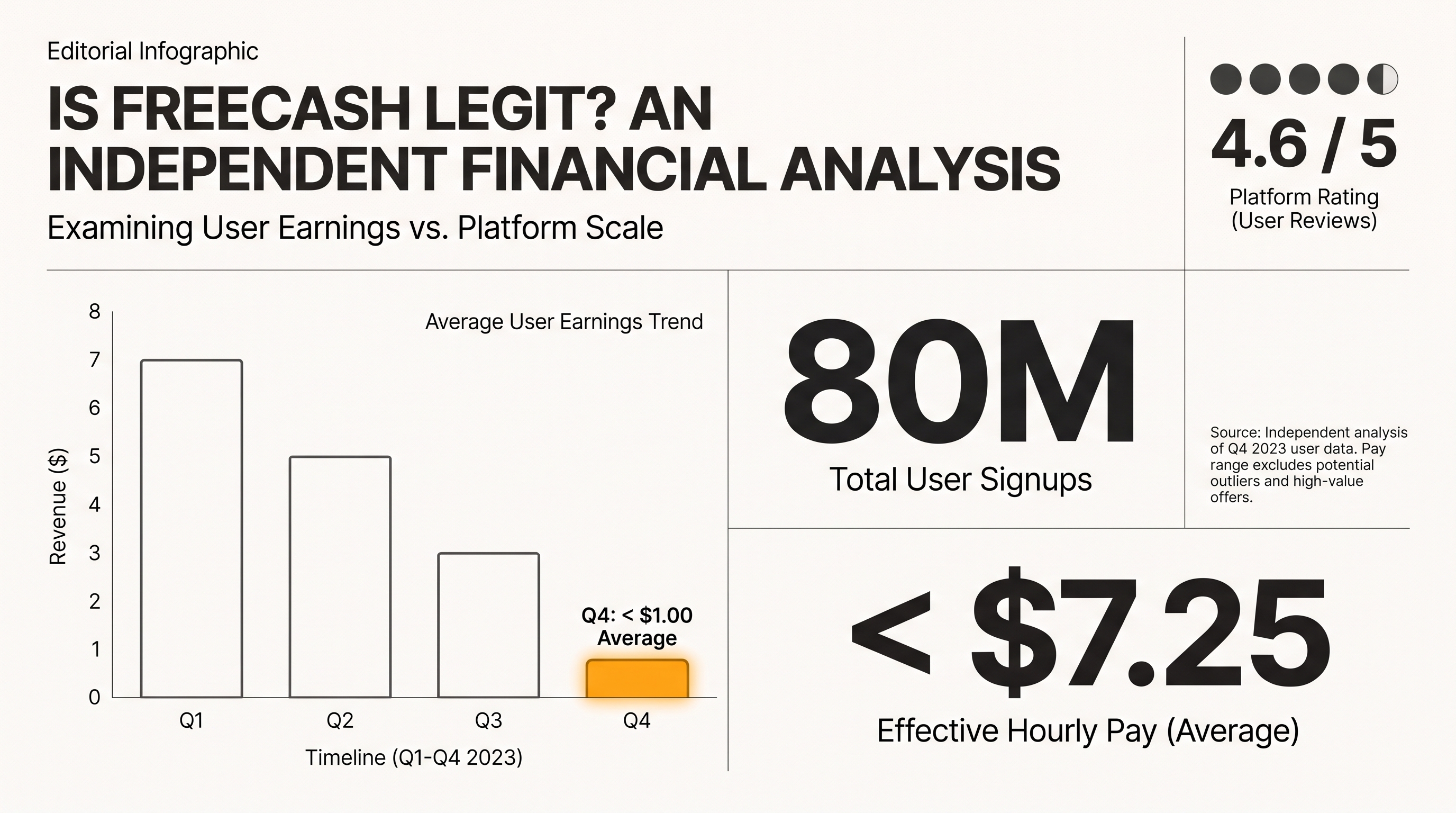
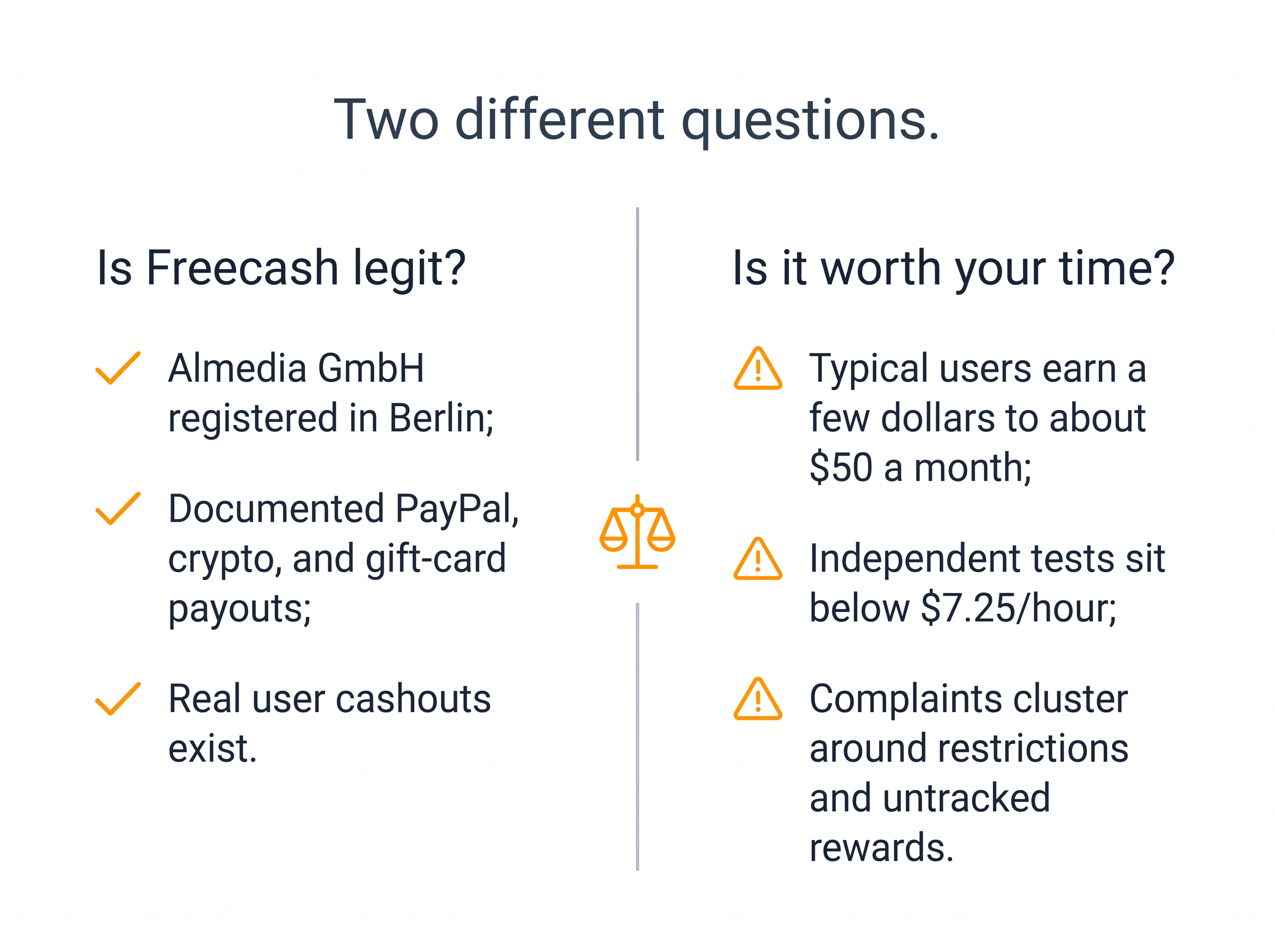
Yes, Freecash is a legitimate get-paid-to (GPT) platform run by Almedia GmbH, a registered company in Berlin, and it has paid users through PayPal, crypto, gift cards, and other methods [3][4]. Legitimate does not mean risk-free or highly profitable. Independent tests show modest effective earnings, and BBB complaints describe account restrictions and missing high-value rewards [1]. Verify offers, don't spend money you can't afford to lose, understand withdrawal fees, and cash out early. Treat Freecash as side income, not a job replacement.
Introduction: Freecash Pays, but Getting Paid Isn't the Same as Good Value
Is Freecash legit? Yes. It is a real rewards platform, not a fake-app scam. It has documented payouts, a registered company behind it, and a user base the company says exceeds 80 million signups [3].
Whether it's legitimate and whether it's worth your time are separate questions. Users have filed complaints about tracking failures, account restrictions, and withdrawal fees. Independent tests put effective hourly pay below the US federal minimum wage of $7.25.
This guide covers what a US user needs to know (most points also apply to European users):
- Does Freecash pay?
- How much do people realistically earn?
- What happened with the 2026 app-store removals?
- Should you hand over ID or banking information?
- Which withdrawal methods cost the least in fees?
The guide draws on BBB complaint data, payout and fee tables, independent earnings tests, and the company's own explanation of its business model. The short answer is that Freecash works best as low-stakes, flexible side income.
What Real Users Say About Freecash Payouts
Most users report that Freecash does pay, usually in small amounts. Trustpilot shows a 4.6/5 rating from more than 300,000 reviews [9]. You may still see older figures quoted, such as 4.0 stars from about 24,000 reviews. Those are out of date.
"Yes, Freecash does pay out for many people, with users reporting cashouts from $20 to over $2,400 via PayPal, Amazon, and crypto. But it's not instant money" — Facebook community answers on Freecash
"Freecash is rated 'Excellent' with 4.6 / 5 on Trustpilot" — Trustpilot review page for freecash.com
"If you're here wondering is freecash app legit, welcome to the club." — TheCashDen, hands-on platform test
These sources agree on three points:
- TheCashDen cashed out through PayPal during its hands-on test and received the payment.
- One Trustpilot reviewer reported earning nearly £30 in two weeks.
- Facebook community answers describe cashouts from $20 to more than $2,400 and stress that earnings take time.
Satisfied users tend to play games they would enjoy anyway and collect daily bonuses and streak rewards. Users who quit usually expected a paycheck. They then spent hours on surveys for very little money or got stuck below withdrawal thresholds.
The pattern holds across sources. People get paid, the amounts are small, and your expectations matter more than which offer you pick. If you already play mobile games, Freecash works more like a rebate on entertainment than a wage.
The 2026 Freecash App-Store Removal: What Happened and What It Means
According to Finder's review, Freecash was temporarily removed from both the Apple App Store and Google Play in 2026 and later returned [2]. That explains why you may not have found the app this spring. The website kept running the whole time.
The 2026 timeline
| Date | Event | What users should understand |
|---|---|---|
| January 23, 2026 | WIRED published an investigation into misleading Freecash ads on TikTok and its model of acquiring users through mobile-game offers | The reporting increased scrutiny of how ads promised earnings |
| January 2026 | Malwarebytes analyzed "get paid to scroll TikTok" ad claims and the data/affiliate funnel behind them | What the ads promised and what the offer terms say are two different things |
| Early 2026 | TikTok removed or restricted ads tied to financial-misrepresentation concerns | An ad platform taking action is not a court finding that payouts are fraudulent |
| Spring 2026 | Apple removed Freecash from the App Store, as reported by TechCrunch; Finder confirms removal from both major stores [2] | The removals raised compliance and advertising questions |
| Later in 2026 | Almedia reported reinstatement on Google Play first, then on the App Store | Confirm current status on the official store listing |
What the removals do and do not prove
An app-store removal is a serious warning sign. It does not show that all users were scammed, that balances disappeared, or that the platform shut down. None of those things happened.
These four issues often get mixed together:
- Platform-policy enforcement
- Advertising misconduct allegations
- Individual payout disputes
- Criminal fraud findings
There is documented evidence for the first three. The fourth would require legal findings, and none exist. Treating these as separate issues gives you a more accurate picture of the actual risk.
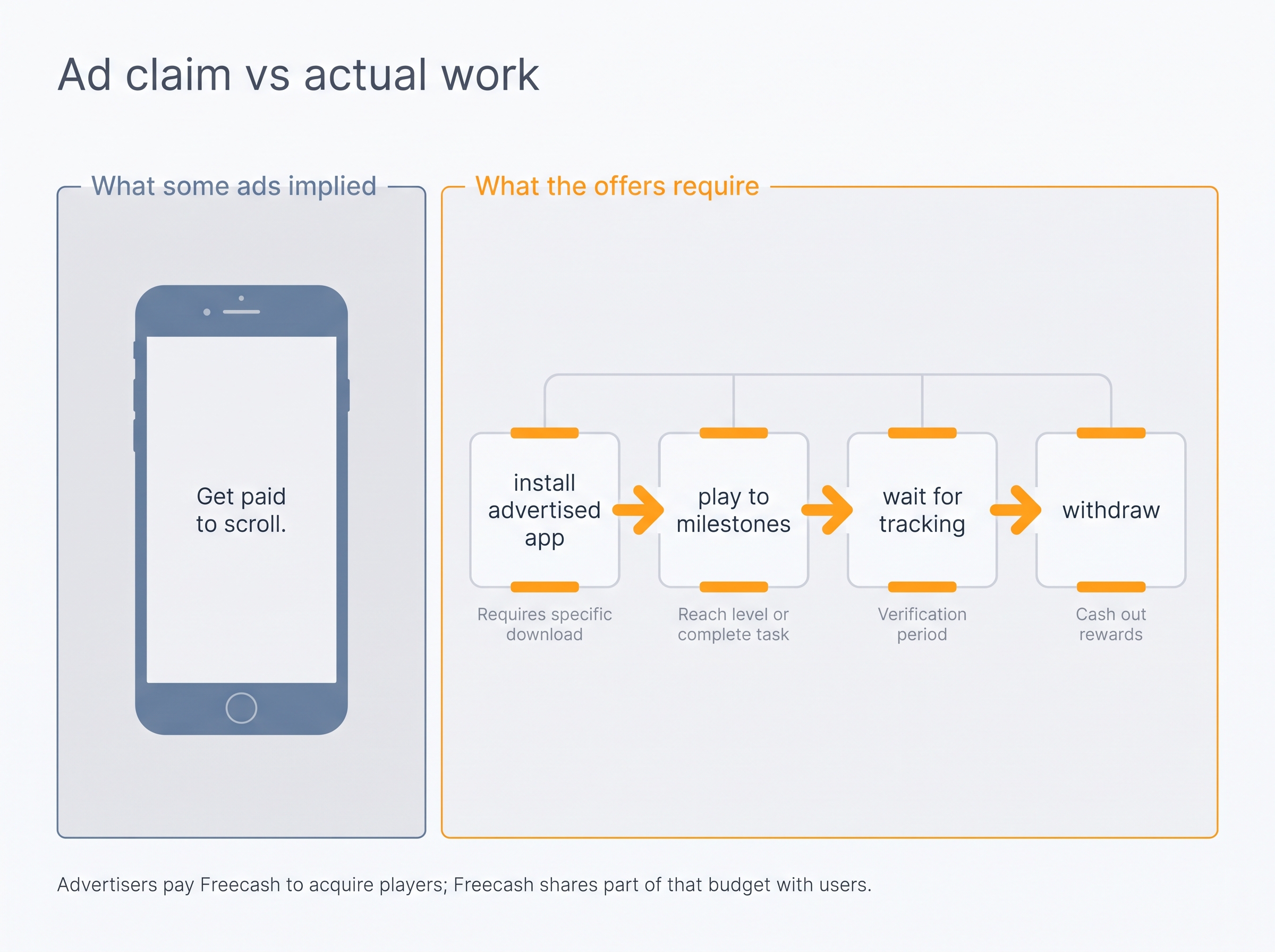
Freecash is open about how it makes money. Advertisers pay Freecash to find users for their games and apps, and Freecash shares part of that budget with the people who complete offers [3]. That's standard across the GPT industry.
The problem was how some ads described the work. WIRED and Malwarebytes both identified the same mismatch. Ads suggested you'd be paid to scroll TikTok. In reality, you install and play advertised games until you hit milestones.
Five precautions to take because of the removals:
- Download only from the verified Apple App Store listing, the Google Play listing, or the official Freecash website.
- Check the developer name and app permissions before installing.
- Ignore TikTok or social ads promising unusually high hourly earnings.
- Read the actual offer terms before installing an app or starting a trial.
- Never submit identity documents through an unofficial mirror or referral page.
How to check current availability
App-store status can change quickly, so this section is accurate only as of publication. Before signing up, check the official app listing, the developer name (Almedia), the most recent update date, and the privacy-policy link. Confirm that the listing points to the official Freecash domain. Note that the website can be available even when the app is not.
How Much Can You Realistically Make on Freecash?
According to Freecash itself, most users earn between a few dollars and roughly $50 a month. Independent tests back this up, with hourly rates generally well under $7.25.
What independent tests found
Expect inconsistent, modest earnings, not the $35 per hour some ads imply. Two published tests show the range:
- FinanceBuzz earned $7.55 in a little over three hours. Of that, $5 was a bonus, so actual tasks paid just $2.55.
- BountyCore's blog published a 12-hour Freecash test that earned $54, or $4.50 per hour.
Your results will depend on your location, which offers you see, survey screening time, bonuses, and whether rewards track correctly.
| Source / activity | Reported result | Interpretation |
|---|---|---|
| FinanceBuzz test | $7.55 total, including a $5 bonus ($2.55 from tasks) over 3+ hours | Shows how low earnings can be once you remove the bonus |
| BountyCore blog's 12-hour Freecash test | $54 total, about $4.50/hour | A better result, but still below the federal minimum wage |
| EarnLab (2026), surveys on GPT sites | Roughly $1–$3/hour | Screening questions and disqualifications pull the rate down |
| EarnLab (2026), sign-ups and trials | Roughly $3–$8/hour | Higher ceiling, but often requires registration, permissions, or payment details |
Side Hustle School's 2026 review gives a "mixed" verdict for the same reason. It calls Freecash a legitimate offer-wall platform where you earn by downloading apps, completing trials, and playing mobile games. It also says the per-hour math lands "somewhere between low and hard to justify" [6].
What these numbers mean for your monthly earnings
The company's own estimate of a few dollars to around $50 a month is a useful baseline, because Freecash has every reason to make its earnings sound good.
When Freecash passed $500 million in user payouts, Almedia also reported these milestones:
- More than 9 million people earn rewards each month.
- Over 1 million users have earned more than $100 in total.
- More than 70,000 users have earned over $1,000.
Measured against 80 million+ signups [3], 1 million users is about 1.25%. Roughly one signup in 80 has earned more than $100 in total. The $1,000+ group is under 0.1% of signups.
Big earners exist, but they're rare. Plan around Freecash's "a few dollars to about $50" estimate, not the screenshots you see in ads.
Compare those numbers with the federal minimum wage of $7.25 per hour. Both full-platform tests above fall below it, and so does EarnLab's survey range. Only the top of EarnLab's sign-up range clears it.
Low pay doesn't make Freecash a scam. It does make many tasks unattractive once you count the unpaid time: screening questions, installs, waiting for rewards to track, and messaging support.
How to calculate your personal effective hourly pay
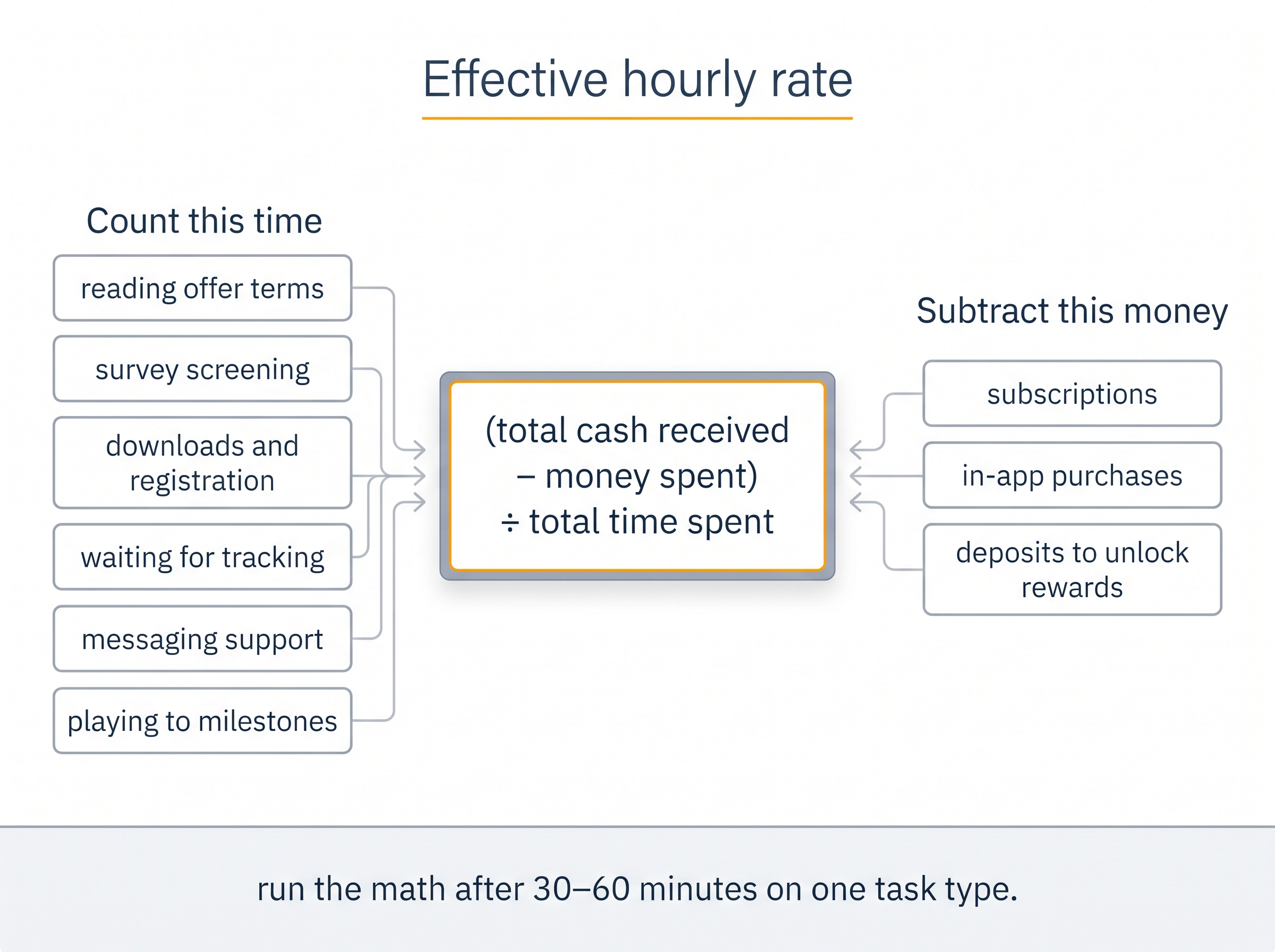
Use this formula:
Effective hourly rate = (total cash received − money spent) ÷ total time spent
"Total time spent" should include:
- Reading offer terms
- Survey screening and disqualifications
- App downloads and account registration
- Waiting for tracking or reward approval
- Messaging customer support
- Playing toward game milestones
"Money spent" covers subscriptions, in-app purchases, and deposits made to unlock rewards.
Most people who feel burned by GPT sites never did this calculation. Spend 30 to 60 minutes on a single type of task, then do the math. You'll quickly see whether it's worth your time.
How to read income claims in ads and screenshots
No independent test cited here supports claims of routine $35-per-hour earnings. Social-media screenshots often include referral bonuses, limited-time promotions, a single unusually high-value offer, combined earnings from several accounts, or gross rewards before expenses.
A screenshot is marketing. An hourly rate is math.
Long-term community users tend to pick games they would play anyway. For them, part of the payoff is the entertainment itself, which is a fair trade as long as you know that going in.
Account Restrictions, Missing Rewards, Fees, and Data-Safety Risks
The biggest documented risk isn't fake payouts. It's losing hours to rewards that don't track or to accounts that get restricted. The BBB file shows 723 complaints in three years, with 566 closed in the last 12 months [1]. Here are the specific risks to understand before you invest time.
Why BBB and Trustpilot tell different stories
| Source | Reported signal | How to interpret it |
|---|---|---|
| BBB profile | Not Rated, not accredited; 723 complaints in three years, 566 closed in the last 12 months [1] | Shows recurring dissatisfaction, not proof that every transaction fails |
| Trustpilot | About 4.6/5 from more than 300,000 reviews [9] | Shows many positive experiences from a much larger and different group of reviewers |
| Independent reviews | Mixed findings on earnings, tracking, and payout speed [2][6] | Useful for spotting patterns, but not a representative survey |
Complaint totals change over time, so check the live BBB profile before drawing conclusions.
A 4.6 Trustpilot score alongside hundreds of BBB complaints isn't a contradiction. The two sites hear from different people. Trustpilot mostly collects reviews from users who cashed out without trouble. The BBB mostly hears from users who hit a problem and escalated it.
Scale matters too. Against 80 million+ signups [3], 723 complaints is a small number. But few frustrated users ever file a formal BBB complaint, so that count understates how many people actually ran into problems.
Common complaint patterns
The recurring complaints tend to look like this:
- Some users report account restrictions shortly before larger withdrawals.
- High-value milestones, such as $70 or $100 rewards, sometimes fail to track even when smaller rewards from the same offer were credited.
One anonymized complaint describes a user who completed a multi-week game offer and reached the final milestone, only to have the account flagged before the $100 reward posted. That is the user's claim, not a confirmed fact.
Many disputes have legitimate explanations:
- Offer-wall tracking failures
- Duplicate accounts
- VPN use or a location mismatch
- Fraud-detection triggers
- The advertiser reversing the reward
- An unmet purchase requirement
Freecash's account of a case may differ from the user's, and both may be partly right. Long game offers carry the most risk because they pay out at the end. If tracking fails at the final milestone, you lose weeks of effort instead of minutes.
Five-step protection checklist
- Take screenshots before you start. Capture the offer page, reward amount, terms, and completion requirements.
- Follow the offer rules. Don't use a VPN, emulator, ad blocker, or anything that causes a location mismatch if the offer terms prohibit it.
- Cash out early and often. Don't let a large balance build up.
- Be wary of offers that require you to spend money. Skip them unless the cost, cancellation process, and expected reward are all clear.
- Keep records. Save receipts, confirmation emails, screenshots, and subscription-cancellation confirmations.
Fees, minimums, and withdrawal choices
| Withdrawal method | Minimum or typical threshold | Fee or timing guidance |
|---|---|---|
| PayPal | About $5; the first withdrawal may be $5–$20 depending on region [10] | Reported 5% fee; often instant to 30 minutes [7] |
| Venmo | Region-dependent | Reported 5% fee [2] |
| Bank transfer | About $5 [7] | Reported 5% fee; about 1–3 business days [7] |
| Gift cards | About $5 [7] | Generally no reported 5% fee; delivery time varies |
| Crypto | About $0.25–$0.50 depending on source and coin [7][9] | Usually no platform fee, but network and exchange costs may apply |
| Stake | As low as $0.10 after the first cashout [10] | Sends funds to a crypto gambling platform; a consumer-risk warning sign |
The 5% fee on PayPal, Venmo, and bank withdrawals adds up. On a $50 cashout, you lose $2.50. Gift cards and crypto avoid that fee, but crypto comes with network costs and price swings.
Freecash's low thresholds are a real advantage. Most users reach the $5 PayPal minimum within their first hour or two of activity [10]. Swagbucks' $25 PayPal minimum takes much longer to reach [8]. Low minimums are also what make cashing out early practical.
ID verification and bank-information safety
Your first cashout will likely require identity verification. Freecash's US privacy policy says it shares the minimum necessary data with two partners [5]:
- Verisoul, for liveness or selfie checks
- Veriff, for ID document scans plus a selfie
Verifying your ID does not give Freecash access to your bank account. The platform doesn't store your bank password and doesn't run a credit check [10]. You should still take basic precautions:
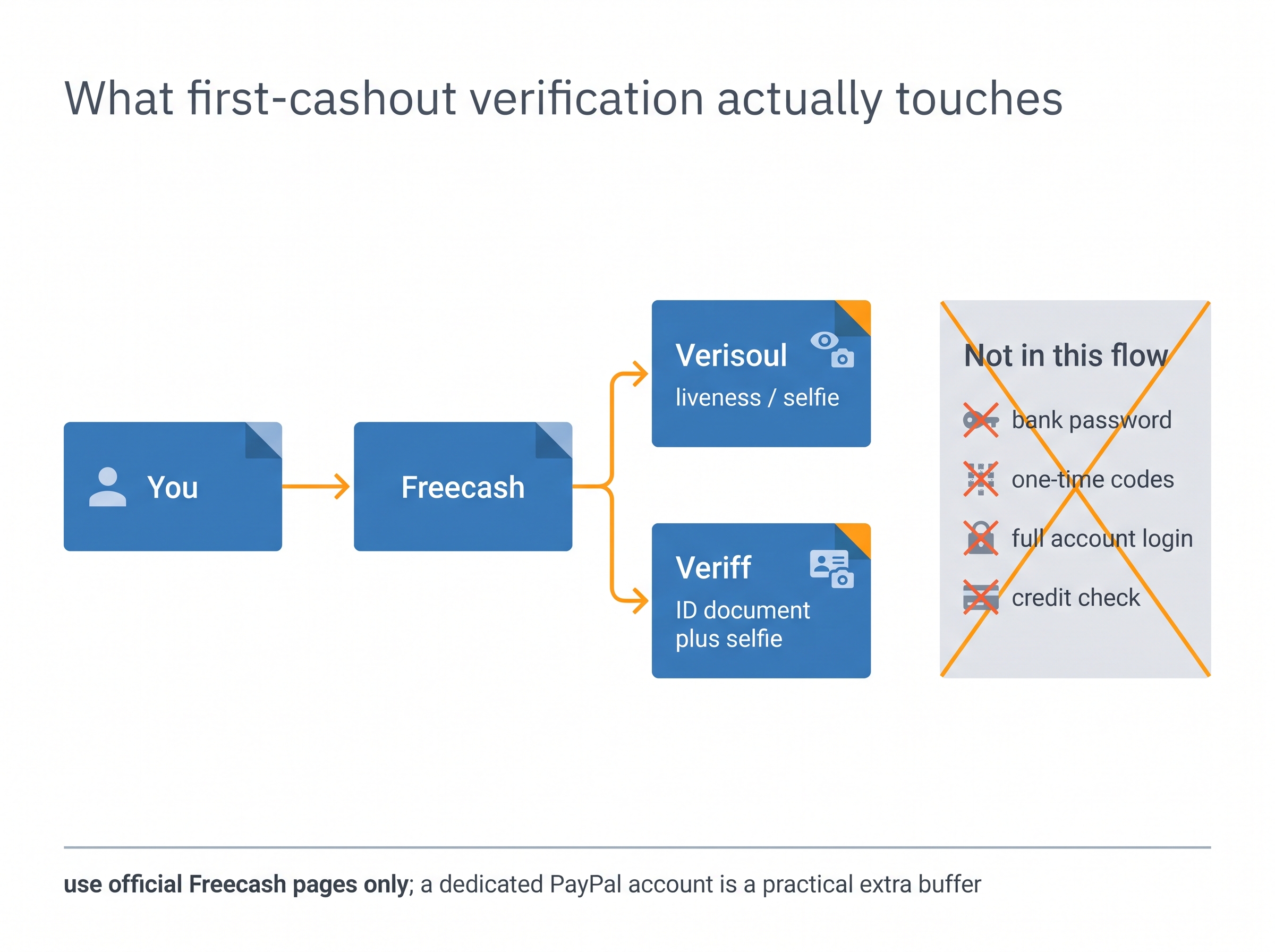
- Use a dedicated PayPal account or payout method where practical.
- Read the US privacy policy before submitting documents.
- Never share a banking password, one-time code, or full account login with anyone.
- Choose gift cards or crypto only if you understand their extra risks.
The verdict: Freecash is legitimate but not risk-free. The payouts are real. The danger is spending a lot of time on offers that don't track, having your account restricted, or earning very little per hour.
Frequently Asked Questions
Does Freecash actually pay out?
Yes. Freecash has documented payouts through PayPal, crypto, gift cards, and bank withdrawals. Almedia reports more than $500 million paid to users. Not every offer is guaranteed to pay, because tracking failures, account restrictions, advertiser reversals, and eligibility rules all affect results. Start with a small offer, save proof that you completed it, and cash out early.
Is Freecash legit or a scam?
Freecash is a legitimate rewards platform, but it isn't risk-free and it isn't a job. It is operated by Almedia GmbH, a company registered in Berlin [3][4], and its payout history and independent tests confirm that users get paid. At the same time, BBB complaints document disputes over restricted accounts, missing rewards, and low earnings [1]. The accurate verdict is "legitimate with important caveats."
How much can you realistically make on Freecash?
According to Freecash itself, most users earn from a few dollars to around $50 a month. Independent tests found $2.55 from tasks in a little over three hours (FinanceBuzz, excluding a $5 bonus) and $54 over 12 hours ($4.50/hour). Be very skeptical of claims of $35 per hour [6].
Is it safe to give Freecash my bank information?
Never give Freecash, or anyone else, a banking password, one-time code, or full account login. First withdrawals may require identity verification through Verisoul or Veriff [5], and bank withdrawals may carry a reported 5% fee [7]. Use official Freecash pages only. PayPal or gift cards may give you a better balance of convenience and privacy.
Which is better, Freecash or Swagbucks?
Freecash vs Swagbucks for US cashouts
| Option | Pros | Cons |
|---|---|---|
| Freecash | Low cashout floors (about $5 PayPal, roughly $0.25–$0.50 crypto) and crypto or gift-card routes that skip the reported 5% payout fee. | PayPal, Venmo, and bank withdrawals may take 5%; tracking failures and account flags show up in complaints; hourly pay is still low. |
| Swagbucks | More earning surfaces and a welcome bonus, which can suit users who want variety beyond game offers. | $25 PayPal minimum is slower to hit; per-hour pay is also weak, so the extra task mix does not automatically mean better wages. |
Freecash suits users who want fast cashouts, crypto options, and low thresholds. Its crypto minimum starts at roughly $0.25–$0.50, while Swagbucks requires $25 for PayPal [8]. Swagbucks offers more ways to earn and a welcome bonus [8]. Neither platform pays well per hour, so compare offer availability, fees, and support in your region.
Is the "earn money" app real or fake?
An earn-money app can be real and still be a poor use of your time. Before signing up, check the developer, privacy policy, payout terms, app-store status, and independent reviews. Avoid any app that promises guaranteed high hourly earnings, asks for unexplained deposits, or requests sensitive login details through ads or messaging apps.
Limitations, Alternatives, and Professional Guidance
Limitations of the evidence
Keep these caveats in mind:
- Review-site ratings aren't representative surveys of all users.
- BBB complaints measure reported dissatisfaction, not confirmed fraud.
- Each earnings test reflects one tester, device, country, and set of offers at one point in time.
- Almedia's own payout totals range from $200 million+ to $500 million because they were published at different times [3].
Payout rules, fees, minimums, and app-store status can all change. Crypto withdrawals also involve price swings, network fees, and possible tax questions. Earnings from reward platforms may be taxable. This article is general information, not financial or tax advice. If your earnings grow, check your obligations or consult a qualified tax professional.
When to consider an alternative
If the problems described here sound familiar, OnlineJobs is worth comparing. It offers microtasks you can start right away, payouts through PayPal, Bitcoin, or Ethereum, and offers advertised at up to $5 each.
We don't claim it always pays more than Freecash. It may suit you better if you dislike high first-cashout requirements, long game milestones, unclear tracking, or offers that require you to spend money. Whichever platform you choose, read the payout terms and privacy policy first.
Conclusion: Is Freecash Legit?
Freecash is a real GPT platform with strong evidence of genuine payouts. It is not guaranteed income and should not replace a job.
Key findings:
- App-store removals: The 2026 removals are a reason for extra caution, even though the app is back in both stores [2].
- Earnings: Independent tests show effective hourly rates below the $7.25 federal minimum wage. Freecash itself says most users earn a few dollars to around $50 a month.
- Complaints: The BBB records 723 complaints in three years, mostly about restrictions and missing rewards [1].
- Fees: PayPal, Venmo, and bank withdrawals may carry a 5% fee [2][7].
- Verification: First withdrawals may require identity checks through Verisoul or Veriff [5].
How to use Freecash safely:
- Start with low-risk offers.
- Never spend money just to unlock rewards.
- Take screenshots of everything.
- Cash out as soon as you reach the minimum.
- Calculate your effective hourly rate, and stop if it isn't worth your time.
If you want another flexible way to earn, look at OnlineJobs' available tasks and payout methods, and run the same hourly-rate calculation to compare.
About the Author
OnlineJobs Team
We're the OnlineJobs team. We write about what we know best, aiming to explain it clearly and help you decide with information you can trust.
Transparency Statement
This article draws on official Freecash and Almedia materials, BBB records, independent reviews, investigative reporting, industry analyses, Trustpilot, and community discussions on Reddit and Facebook. OnlineJobs, the publisher of this article, is mentioned as an alternative. Figures such as complaint counts, review totals, payout minimums, fees, and app-store availability can change. Check time-sensitive numbers against the live sources before you act on them.
References
[1] Freecash Reviews and Ratings
[2] Freecash Review: Is It Legit and Worth It? (2026)
[4] Is Freecash Safe? Complete 2026 Security & Payout Guide
[5] Freecash: Get Paid for Games & Surveys | Earn Real Cash
[6] Is Freecash Legit? Yes, But the Pay Is Low (2026)
[7] How Does Freecash Make Money? Business Model Explained 2026
[8] Swagbucks vs Freecash: Which App Pays More in 2026?
[9] Swagbucks vs Freecash: Which to Pick? [2026]
[10] Is Freecash Legit? What Is Freecash in 2026? - Firstcard